
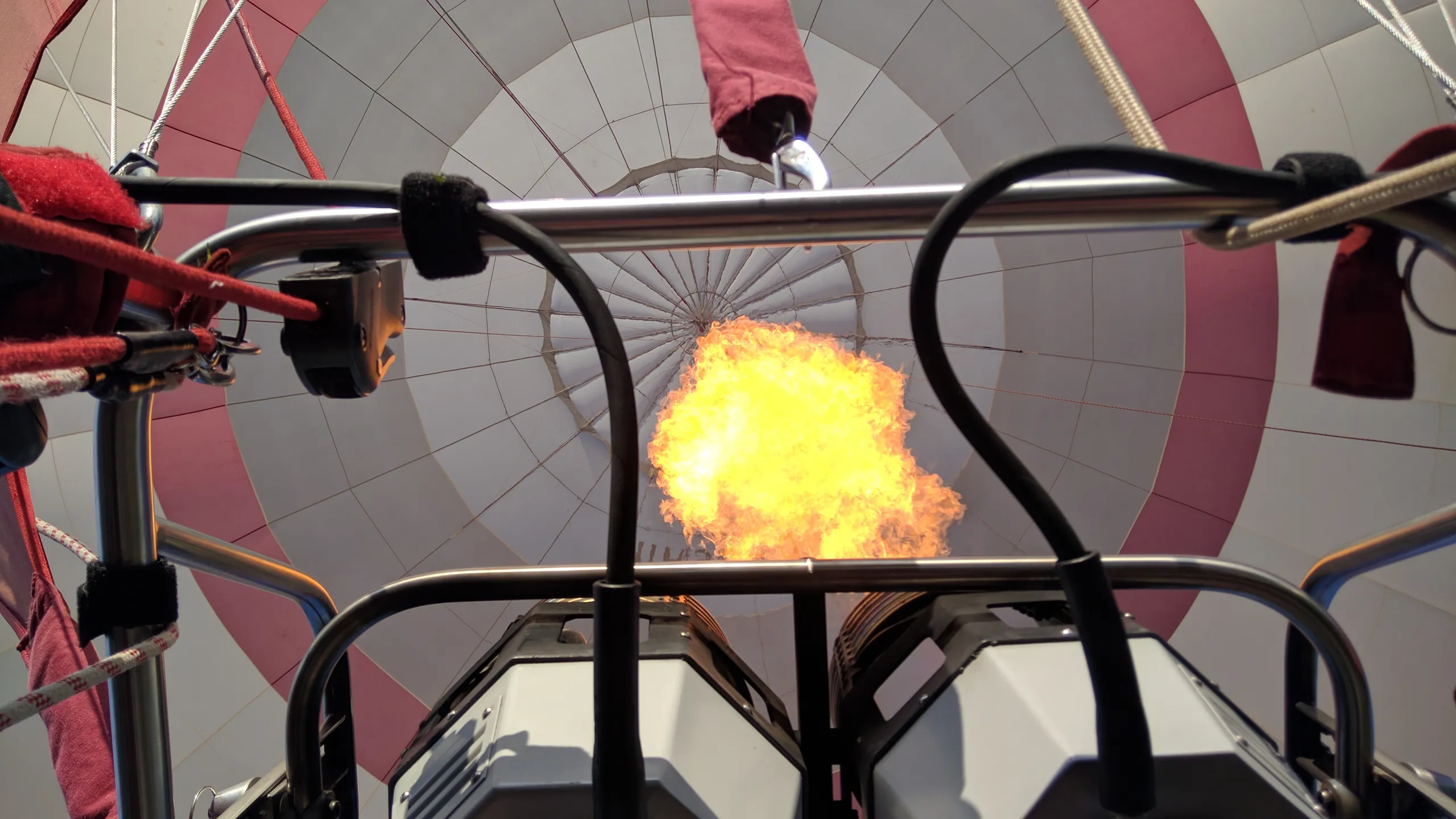
A hot air balloon is aviation reduced to its essentials: a fabric bag of hot air, a flame to keep it hot and a basket for the humans. There is no wing, no engine and no steering wheel, yet a good pilot can drift for an hour and set the basket down in a chosen field. This section explains the whole machine in plain language, one piece at a time.
The short version fits in a sentence: heated air is less dense than the cool air around it, so the atmosphere itself pushes the balloon upward, and the pilot steers by climbing or descending into winds that blow different ways at different heights. Everything else is refinement layered onto that one idea over 240 years.
The machine has three parts, and only three.
- The envelope is the balloon itself: around 1,000 square metres of coated ripstop nylon on a typical ride balloon, sewn into vertical panels called gores and opened for landing by a parachute valve at the crown. Fabric is a consumable; envelopes log every flight hour and retire at 400 to 600 hours, a lifespan traced in the life of an envelope.
- The burner runs on liquid propane from tanks in the basket corners and can throw a flame several metres tall. Commercial balloons carry two, each on its own fuel line, so a failed valve never leaves the envelope cold. The plumbing is walked through in anatomy of a balloon.
- The basket is still hand-woven willow for a blunt reason: wicker flexes on touchdown, absorbs the hit and springs back into shape. Why the basket is wicker covers what aluminium and fibreglass kept getting wrong.
Steering deserves the honest answer too. A balloon has no rudder and no throttle to fight the wind; altitude is the only control. Winds often blow in different directions at different heights, so the pilot climbs or sinks to find a layer heading somewhere useful, a craft unpacked in how pilots steer. The arithmetic behind the lift lives in the science, and the family tree from montgolfiere to solar balloon is in types of balloons.
Understanding the machine also answers the question most first-timers actually arrive with, which is how safe balloons really are. And once you see why a big temperature gap means strong lift, you will understand why every flight in the world leaves at first light, a logic laid out in the best time to fly.
The machine, piece by piece
Six short guides, each answering one question properly. Start anywhere.

Anatomy of a balloon
Envelope, parachute valve, burner, tanks and basket: a guided tour from crown to floor.

Why hot air lifts
Archimedes, air density and the honest arithmetic behind a four-passenger flight.

How pilots steer
No rudder, just altitude: riding stacked wind layers and the famous Albuquerque Box.

Why the basket is wicker
A hand-woven crumple zone that has outlasted metal and fiberglass for 240 years.

Types of balloons
Montgolfiere, gas, Roziere, cloudhopper, solar, and the special shapes in between.

Life of an envelope
Born from 1,000 square metres of nylon, retired after 400 to 600 flight hours, reborn as tote bags.
One habit of the machine is worth knowing before you ever ride in one: a balloon answers slowly. Heat poured in now changes the climb many seconds later, so pilots fly half a minute ahead of the aircraft, adding warmth for a hill that is still a field away. Watching a pilot's hand rest on the burner valve, apparently doing nothing, is watching someone hold a conversation with the future.
From understanding to standing in the basket
The natural next step is watching a crew build this aircraft around you at dawn. Here is exactly how a first flight morning goes, minute by minute.