
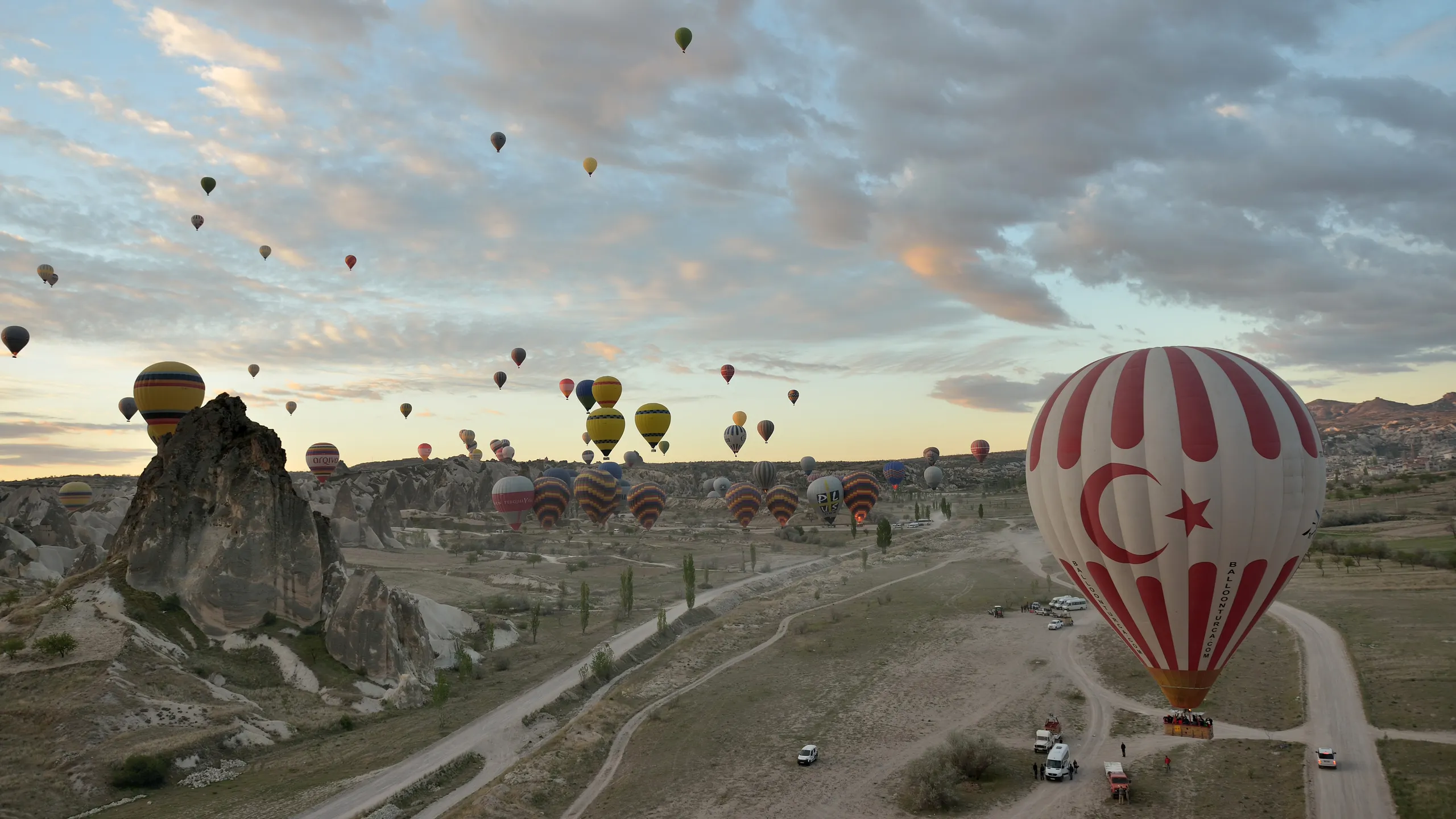
Ballooning has its own dialect, a mix of 1783 French, aviation regulation and launch-field slang. Here are the words you will actually hear, grouped by where they come up: on the balloon itself, in the air, among the crew, and at festivals and competitions.
The balloon
Envelope: the fabric bag that holds the hot air, usually rip-stop nylon with a heat-resistant coating. Everything else hangs from it; the full tour of parts is in anatomy of a balloon.
Gore: one vertical segment of the envelope, running from the mouth up to the crown. An envelope is sewn from a dozen or more gores, each built of smaller panels.
Crown: the top of the envelope, with a load ring at its center. During inflation a crew member steadies the balloon with a rope attached there, the crown line.
Parachute valve: the circular panel of fabric seated in the crown. Pull the red line and it opens to spill hot air; release it and internal pressure seats it shut again.
Skirt: the collar of fire-resistant fabric at the mouth of the envelope. It shields the flame from wind and funnels heat where it belongs.
Burner: the propane-fed heart of the machine, mounted on a frame above the basket. A modern double burner puts out heat measured in the tens of millions of BTU.
Whisper burner: a secondary burner that runs on liquid propane with a softer, quieter flame. Pilots switch to it over villages and livestock, out of courtesy and self-preservation.
Montgolfiere: the French word for a hot air balloon, after the brothers who invented it in 1783. Still the standard term in much of Europe.
Charliere: a gas balloon lifted by hydrogen or helium instead of hot air, named for Jacques Charles, who flew one within days of the Montgolfiers' first manned ascent.
Roziere: a hybrid of gas cell and hot air, named for Pilatre de Rozier. The design behind every successful round-the-world balloon; see types of balloons for how the three compare.
Cloudhopper: a tiny one-person balloon with a harness or bucket seat instead of a basket. The pilot dangles in open air, usually grinning.
In the air
Variometer: the instrument that shows rate of climb or descent. Balloons respond to the burner with a long delay, so pilots fly the variometer more than the view.
Pibal: short for pilot balloon, a small helium balloon released before flight and watched as it rises. Its drift maps the wind at each altitude, which is the whole steering plan; see how pilots steer.
False lift: apparent buoyancy created by wind flowing over the envelope while the balloon is still on the ground. It vanishes moments after takeoff, which is why pilots treat windy launches with suspicion.
Weigh-off: the pre-launch buoyancy check. The crew briefly lets the balloon float to judge whether it is light enough to climb with its load, then the pilot trims heat accordingly.
Tether: flying while anchored to the ground by ropes. This is how balloon glows, try-it rides and windy-day displays work.
Drop line: a long rope the pilot lowers to the ground crew so they can walk the balloon into a tight landing spot, like docking a very slow ship.
Splash and dash: skimming the basket onto a lake or river and lifting off again. Spectacular, occasionally soggy, and strictly a calm-morning trick for experienced pilots.
People and crew
Aeronaut: the original word for a balloon pilot, in use since 1783 and still found in regulations and record books. Wear it proudly; it predates "aviator" by more than a century.
Chase crew: the team that follows the flight by road, radios the pilot, packs the balloon and drives everyone back. The unsung half of every flight.
Balloonmeister: the official in charge of flying operations at a balloon event. Decides each session's go or no-go, and holds the weather briefing everyone pretends not to be nervous at.
Events and competition
Mass ascension: the coordinated launch of an entire festival field, wave after wave. Albuquerque's are the largest anywhere; our guide to balloon festivals covers where to see one.
Balloon glow: an evening display of tethered balloons lit from inside by their burners, usually fired in choreographed pulses. No flying involved, maximum photography.
Hare and hounds: a classic competition format. A "hare" balloon launches first; the pursuing "hounds" try to drop their markers closest to wherever it lands.
Vocabulary acquired
You can now nod knowingly at a weigh-off. The next step is hearing these words used for real, at dawn, in a field.