
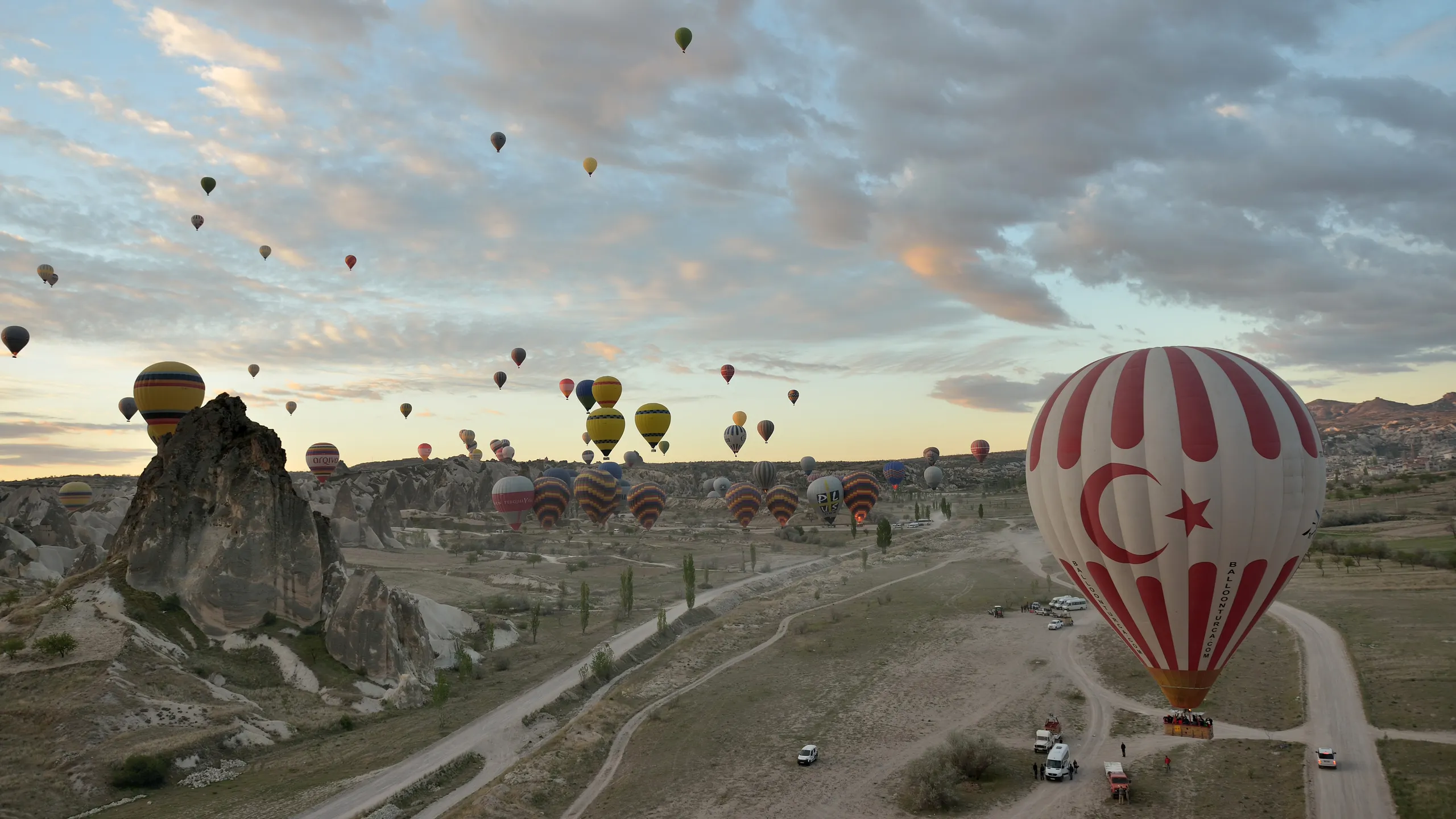
The hot air balloon in your tour photos is not an eighteenth-century survivor. It was invented in 1960, in Nebraska, by a self-taught engineer named Ed Yost, with money that came from the US Navy. The modern hot air balloon is younger than the Boeing 707, younger than the transistor radio, younger than many of its own pilots' parents. This is the story of the second birth.
The strange death of the hot air balloon
The montgolfiere had a short first life. Within weeks of the 1783 flights, hydrogen balloons showed they could fly farther and longer without an open fire aboard, and hot air was abandoned for the better part of two centuries. By the 1930s ballooning of any kind was fading, and after the Second World War it was close to extinct as a sport. What kept lighter-than-air flight alive was science. The US Office of Naval Research paid for high-altitude work, and the aeronautical research division of General Mills, the Minneapolis flour company, built enormous plastic stratospheric balloons under those contracts. One of the men who first chased its balloons by plane and then engineered them was Ed Yost.
Three inventions in one basket
In 1956 Yost and three colleagues left the General Mills program to found Raven Industries in Sioux Falls, South Dakota. An Office of Naval Research contract soon asked them for something odd: a cheap, reusable balloon that could carry one pilot to 10,000 feet and fly for three hours. Later reporting, including a detailed history published by the operator Seattle Ballooning, ties the Navy's interest to Cold War programs; whatever the motive, the specification forced Yost to solve the problem the Montgolfiers never cracked, a fire the balloon could carry. His answer had three parts. A propane burner running on bottled fuel, so the pilot could reheat the air in flight. A light, tight envelope of ripstop nylon in place of paper and linen. And a workable deflation system, so the envelope could be emptied fast on touchdown instead of dragging the basket across the prairie. He had already tested a kerosene-heated prototype on a tether in October 1955. By 1960 the pieces finally worked together.
Bruning, Nebraska, 22 October 1960
That morning Yost lifted off from a disused army airfield at Bruning, Nebraska, under a 40-foot nylon envelope, and flew free. Accounts of the flight differ in one detail: a contemporary National Geographic report gives 1 hour 35 minutes aloft, while the National Balloon Museum's account and the marker at Bruning say 25 minutes and three miles. Nobody disputes what it was: the first free flight of a modern hot air balloon, the ancestor of everything at your launch field. Raven sold its first civilian sport balloon in November 1961. On 13 April 1963 Yost and Don Piccard flew a Raven balloon across the English Channel, a feat that did for the new sport roughly what Blanchard's 1785 crossing had done for the old one.

From invention to sport
The sport organized itself quickly. Yost helped found the Balloon Federation of America and helped set up the first US national championship at Indianola, Iowa. In February 1973 Albuquerque, New Mexico hosted the first World Hot Air Balloon Championship, and the fiesta that grew up around ballooning there is now the largest balloon event in the world, with hundreds of envelopes rising on a single October morning. There is more on it in our guide to balloon festivals.

Cappadocia and the ride boom
Once balloons were factory-built and airworthiness-certified, a new business became possible: selling the view. Ride operations spread through the United States and Europe in the 1970s and 1980s, and in the early 1990s commercial flying began over the rock valleys of Cappadocia in Turkey, today the busiest balloon sky on earth. The machine designed for a Navy contract became the world's favourite sunrise vehicle. What a ride costs, and how to pick a good company, is covered in our guide to balloon ride prices.
Fly Yost's invention
Propane burner, ripstop nylon, quick deflation on landing: every flight today runs on the 1960 recipe. Here is how your first one goes, minute by minute.
Modern balloon FAQ
When was the modern hot air balloon invented?
Its first free flight was on 22 October 1960 at Bruning, Nebraska, piloted by Ed Yost. The propane burner, ripstop nylon envelope and deflation system he combined are still the basis of every hot air balloon flying today.
Why did hot air ballooning disappear for nearly two centuries?
The original Montgolfier system heated air over a ground fire, so a balloon cooled and sank soon after launch, and open flames under paper envelopes were dangerous. Hydrogen and later helium worked better, until bottled propane let a balloon finally carry its own controllable fire.
Who paid for the modern balloon's development?
The US Office of Naval Research, through a contract with Ed Yost's company Raven Industries, which grew out of the General Mills high-altitude balloon program. Later reporting links the funding to Cold War projects; the contract itself specified a cheap, reusable one-man balloon.
When did balloon rides start in Cappadocia?
Commercial flights over Cappadocia began in the early 1990s, decades after the ride industry took off in the United States and Europe. The region is now the busiest commercial ballooning area in the world.