
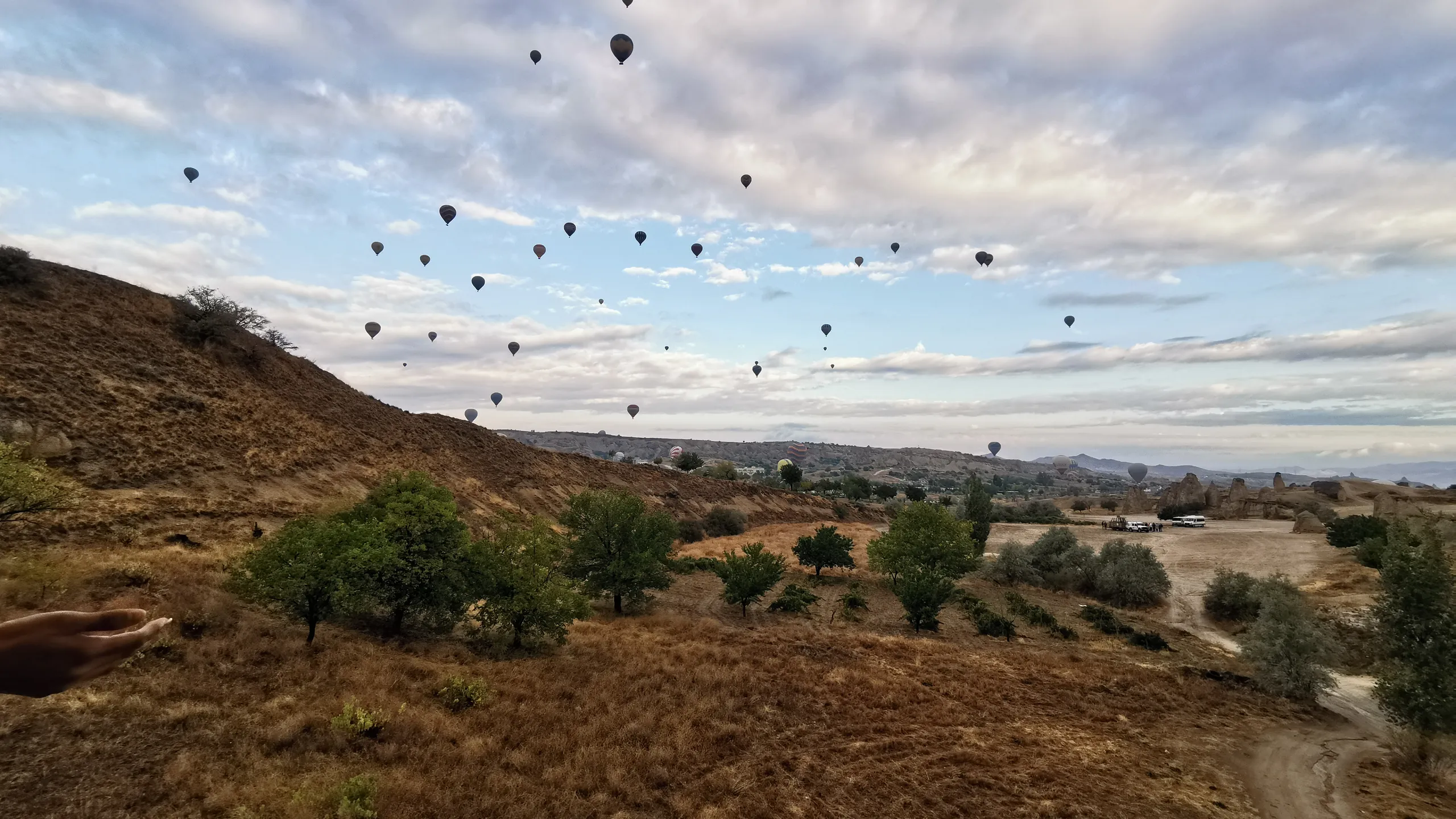
Most balloon trivia lists recycle the same myths, so here are ten facts that hold up. Some are physics, some are history, one involves a sheep with a better name than most racehorses. Where a claim turns out to be legend, we say so. Where it is documented, we link to the longer story elsewhere in the guide.
The facts, in ascending order of strangeness
1. You feel no wind up there
A balloon moves at exactly the speed of the wind carrying it, so the air around the basket is still. Old instructors make the point with a candle: light one on the basket rim in a 20-knot breeze and the flame stands straight up. You are not flying through the wind, you are part of it. Hair stays put, scarves hang limp, and the world slides by underneath.
2. Fear of heights mostly stays on the ground
People who avoid glass elevators routinely stand at 2,000 feet in an open wicker box and feel fine. The height reflex needs a visual chain to the ground, an edge, a wall, something the brain can trace downward. A balloon offers none, so the fear rarely fires. Pilots see it on every flight: nervous passengers relax within minutes, because the view reads as scenery, not as a drop.
3. The modern balloon is younger than the Boeing 707
Hot air ballooning faded once hydrogen and then airplanes took over, and for decades almost nobody flew hot air at all. The modern balloon dates from 22 October 1960, when Ed Yost lifted off from Bruning, Nebraska under a nylon envelope heated by a propane burner. The Boeing 707 had been carrying passengers since 1958, so the aircraft in your holiday photos is younger than the jet age. Read how 1960 changed everything.
4. The first passengers were a sheep, a duck and a rooster
On 19 September 1783 at Versailles, before Louis XVI and a large crowd, a Montgolfier balloon carried a sheep, a duck and a rooster aloft for about eight minutes. The sheep was afterwards named Montauciel, roughly "climb to the sky". All three landed alive, which settled the question of whether the upper air could be survived. Humans followed within two months. The Montgolfier story only gets stranger from there.

5. Jules Verne never put a balloon in Around the World in Eighty Days
Verne did write a balloon novel, Five Weeks in a Balloon, in 1863. But Around the World in Eighty Days, published a decade later, contains no balloon at all: Phileas Fogg travels by train, steamship and, briefly, elephant. The balloon arrived with the 1956 film and has squatted on book covers ever since. We unpack the whole mix-up in balloons in books, movies and art.
6. The champagne story is a legend
The tale gets told at almost every landing: early aeronauts supposedly carried champagne to calm farmers who took balloons for dragons or demons. It is a lovely story with no known period source, and no 1783 document backing it has ever surfaced. The toast itself is real and worth having. We sort documented customs from folklore in balloon traditions.
7. Airmail was born in a besieged city
When Prussian armies surrounded Paris in 1870, the city floated its post out. Over four months, some 66 balloons carried roughly 2.5 million letters across enemy lines, plus passengers including Leon Gambetta, a government minister. It was the first large-scale airmail service in history, run under fire from a starving capital. The full story is in balloons at war.
8. Envelopes retire like airliner parts
A balloon envelope is a consumable, like tires on an airliner. Heat and ultraviolet light slowly weaken the fabric and its coating, so envelopes log every flight hour and retire when the material no longer passes strength tests, typically after 400 to 600 hours. Commercial operators track this the way airlines track engine cycles. Our guide to envelope life explains the tests.
9. Wicker still beats carbon fiber
Basket makers have tried aluminum, fiberglass and carbon fiber, and they keep returning to willow and rattan. Wicker flexes on touchdown, absorbs the hit, then springs back into shape. Composites transmit the shock straight to your ankles, or crack outright. Wicker is also easy to repair and, frankly, better looking. The wicker basket has survived every attempt to modernize it.
10. Every balloon is a registered aircraft
That colorful thing overhead is an aircraft in the full legal sense. Balloons carry registration marks, pilots hold licenses with commercial ratings required for paid flights, and each balloon passes an annual inspection, with extra checks every 100 flight hours for commercial machines. Maintenance logs, airworthiness certificates, insurance: all of it applies. The paperwork is one reason the safety record looks the way it does.
Ready to test fact number one?
The candle stays lit, the ground slides by, and an hour disappears. Here is what a first flight actually feels like, minute by minute.
Quick questions
How high do sightseeing balloons usually fly?
Most passenger flights drift between treetop height and around 3,000 feet, depending on airspace and the pilot's plan for the morning. Record flights have gone far higher, but sightseeing stays low, where the view is.
Can a hot air balloon fly in the rain?
No. Rain adds weight to the envelope, cools the air inside, and heating wet fabric steams and slowly degrades the coating. Operators cancel when rain is forecast and rebook you for a drier dawn.
Why do hot air balloons fly so early in the morning?
Because the air is calmest and most stable around dawn, before the sun heats the ground and stirs up thermals. Balloons need light, steady wind to launch and land well, and sunrise delivers it most reliably. The full reasoning is in the best time to fly.