

Hot Air Balloon Trips in Egypt
Nile cruises and multi-day itineraries with a sunrise balloon ride over Luxor included.
Commercial ballooning in Egypt happens in one place: Luxor, over the west bank, at dawn. Aswan does not fly. Cairo does not fly. What changes between the 42 trips listed here is everything around that hour in the air: whether you buy the flight more or less on its own, add the Valley of the Kings on the ground afterwards, or fold the whole thing into a Nile cruise that sails on to Aswan.
That price spread deserves a warning, because it is the single thing most likely to mislead you here. The cheapest seat on this page and the one buried inside a four-day cruise are in the same basket, at the same hour, on the same morning. Nobody is flying higher or longer for a thousand euros. What separates the two figures is the boat, the hotel nights, the Egyptologist and the transfers bolted on either side of a flight that lasts about forty minutes either way. If the balloon is what you came to Egypt for, the cheap end of this list is not a reduced version of it. If you want the temples explained by someone who knows them, that is a real thing to pay for, but pay for it knowingly.
Choose a destination in Egypt

Hot Air Balloon Experiences in Egypt
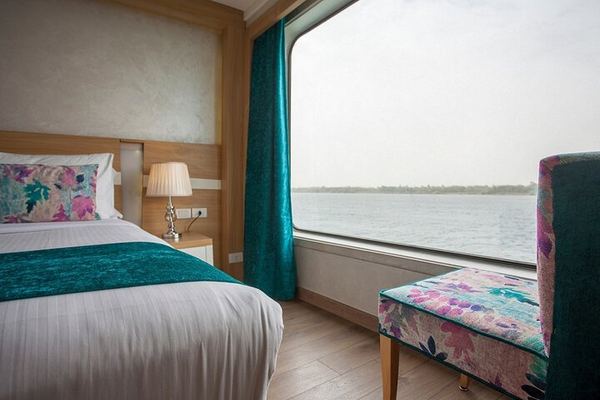
3 Night Nile Cruise Luxor to Aswan with Balloon Ride
The shortest and lowest priced Nile cruise here: three nights Luxor to Aswan, full board, Egyptologist guide and a sunrise balloon over Luxor.

4-day Aswan to Luxor Nile Cruise with Balloon Flight
Four days sailing the Nile from Aswan to Luxor, with Abu Simbel, the river temples and a sunrise balloon flight over the Theban west bank.

4-day Nile Cruise: Aswan to Luxor, Abu Simbel, Balloon
One 4-day package from Aswan to Luxor: transfers, boat accommodation, Abu Simbel, the Nile temples and a sunrise hot air balloon flight.
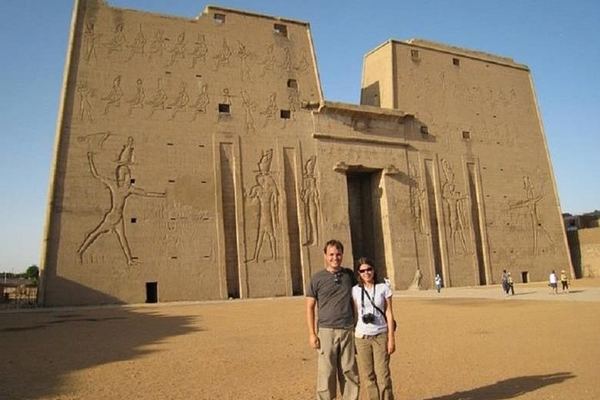
4 Night Nile Cruise Luxor to Aswan, Balloon & Abu Simbel
Four nights Luxor to Aswan with Abu Simbel and a dawn balloon over the west bank. The cheapest 5 day cruise listed here: check what the price leaves out.
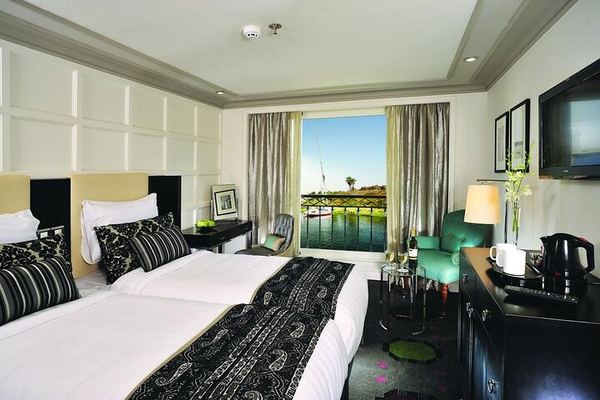
5-Day Luxor to Aswan Nile Cruise, Abu Simbel & Balloon
Five days and four nights Luxor to Aswan on a 5-star ship, with Valley of the Kings, Edfu, Kom Ombo, Abu Simbel and a dawn Luxor balloon.
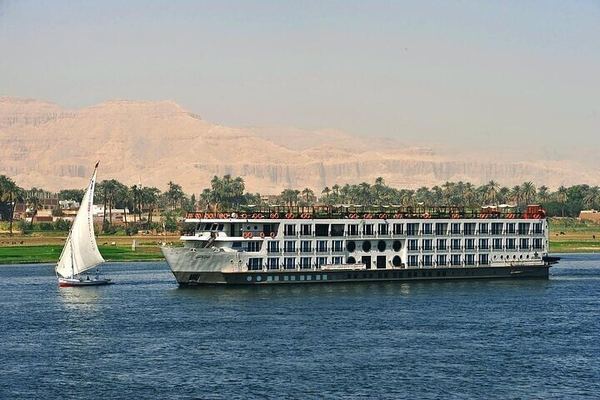
5 Day Nile Cruise Luxor to Aswan, Balloon, Fees Included
Four nights Luxor to Aswan with all meals, transfers, guide, balloon and entrance fees between Luxor and Aswan included. Rated 5.0 from 20 reviews.
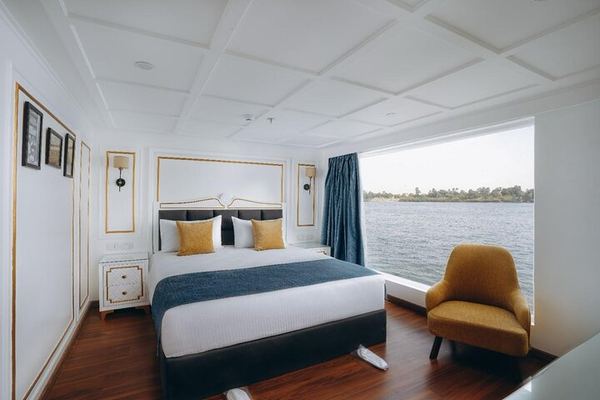
5-Day Nile Cruise Luxor to Aswan, Temples & Balloon
Five-day Nile cruise from Luxor to Aswan with the Valley of the Kings, Karnak, Edfu, Kom Ombo, Abu Simbel, Philae and a dawn balloon flight.
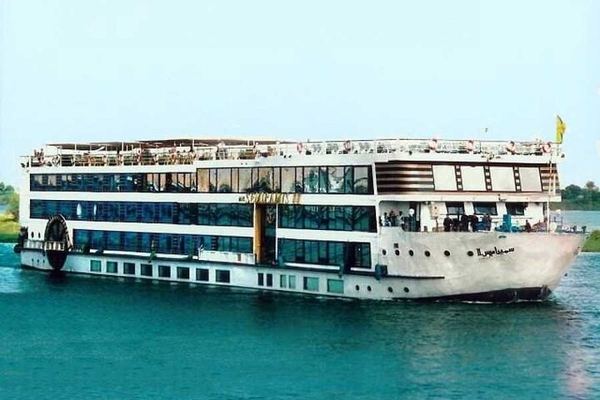
Aswan to Luxor Nile Cruise, 2 Nights, Abu Simbel & Balloon
A 2-night Nile cruise north from Aswan to Luxor, with Abu Simbel, Kom Ombo, Edfu and a dawn hot air balloon flight over the Theban west bank.

Balloon Flight + Valley of the Kings with an Egyptologist
Full-day Luxor program: sunrise balloon flight, then the Valley of the Kings, Hatshepsut's temple and the Colossi with a private Egyptologist guide.

Guided Hot Air Balloon Ride over Luxor at Sunrise
A guide flies with you and explains the west bank while it is still in view. The premium end of Luxor ballooning, with commentary throughout.

Hot Air Balloon and Best of Luxor Full Day Tour
The balloon flies at dawn over Luxor, then a private Egyptologist guide takes the day on the ground: Valley of the Kings, Hatshepsut, Karnak and Luxor Temple.

Hot Air Balloon and Full Day Luxor Tour with Lunch
Sunrise over the Valley of the Kings from the basket, then a full guided day in Luxor with lunch, hotel pickup and drop-off included.

Hot Air Balloon Luxor: Take Off Before Sunrise
This flight lifts off before first light, so the sunrise arrives at eye level from the basket instead of from the launch field below.

Hot Air Balloon Luxor, Valley of the Kings & Hatshepsut
Cross the Nile by motorboat, fly 40 to 45 minutes over the desert at sunrise, then visit the Valley of the Kings and Hatshepsut's temple.

Hot Air Balloon Luxor with Hotel Transfers Included
Air-conditioned round-trip transfers from a central Luxor hotel, English live commentary and a sunrise flight over the west bank, all in one booking.

Hot Air Balloon Over Luxor: 40 Minutes Above the Tombs
A 40-minute sunrise hot air balloon ride over Luxor's west bank, flying above the temples and tombs. The simple option, with nothing else attached.

Hot Air Balloon over the West Bank of Luxor, Egypt
An early car pickup, a boat across the Nile and about an hour in the air over the west bank. A plain morning flight, back at the hotel by breakfast.

Hot Air Balloon Ride in Luxor, Early Morning Flight
The lowest-priced balloon flight on the site: an early morning ride over Luxor with hotel and cruise ship pickup included by the operator.

Hot Air Balloon Ride over Luxor's Open Air Museum
Almost everyone sees Luxor from ground level. This sunrise balloon flight reverses the angle and shows the temples as whole plans from above.
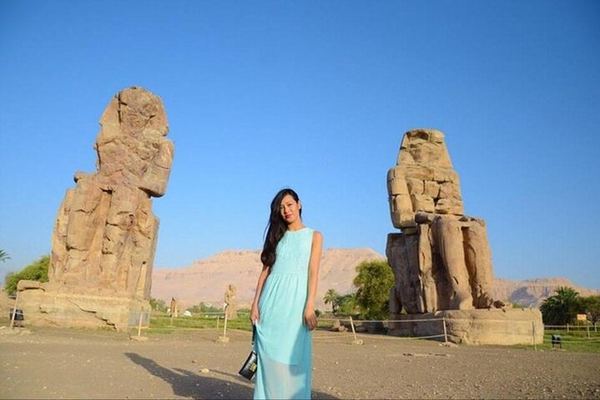
Luxor Balloon Ride and West Bank Temples Day Tour
A 45-minute sunrise balloon flight plus a guided west bank day: Valley of the Kings, Hatshepsut, Medinet Habu. Rated 5.0 from 27 reviews.

Luxor Hot Air Balloon, Both Banks and Valley of the Queens
Both banks of the Nile in one day: a sunrise balloon flight, the west bank sites, the Valley of the Queens and Luxor Temple in the evening.

Luxor Hot Air Balloon Flight at Sunrise with Hotel Pickup
Crossing to the west bank by motorboat, then 45 to 75 minutes above the Valley of the Kings and Hatshepsut's temple. Round-trip hotel pickup included.

Luxor Hot Air Balloon Sunrise Ride, Hotel Transfers
Pickup and drop-off both included, from a Luxor hotel or a Nile cruise boat, for a sunrise flight over the west bank. Nothing to arrange at 4am.

Luxor in One Package: Balloon Flight and West Bank Tour
One booking, one morning: sunrise balloon flight over the Valley of the Kings plus a guided west bank tour to Hatshepsut and the Colossi of Memnon.
Ratings collected by Viator and Tripadvisor
What these trips cover
Two shapes dominate. The short one is a two-night cruise from Luxor to Aswan with the flight on the first morning, before the boat casts off. The longer one runs four days in the opposite direction, from Aswan down to Luxor, adding Abu Simbel and the temples that line the river: Philae, Kom Ombo, Edfu, then Karnak and Luxor Temple at the end. Accommodation is on the boat, meals and an Egyptologist guide are normally part of the price, and the balloon appears as one item on a long list.
The history under the flight path
Twelve dates that explain why the monuments stand where they do, from the first unified kingdom to the museum that opened at Giza in November 2025.
The origins
-
c. 3100 BC
Narmer unites the two lands
Narmer, whom most Egyptologists identify with the Menes of the later king lists, brought Upper and Lower Egypt under one crown and founded the First Dynasty. Everything on this page, from Giza to the tombs opposite Luxor, belongs to the state he started. Egypt has a more or less continuous written record from this point on.
-
c. 2600 BC
The Great Pyramid goes up at Giza
Khufu's tomb was built over roughly 26 years during the Fourth Dynasty. At 146.6 metres it stayed the tallest thing humans had made for more than 3,700 years, with each side of the base running about 230 metres. Giza is far downstream of Luxor, which is why the pyramids are a Cairo day out and never a balloon morning.
-
c. 1500 BC
The first royal tombs are cut opposite Thebes
For nearly 500 years, from the Eighteenth Dynasty to the Twentieth, pharaohs were buried in a dry wadi on the west bank instead of under pyramids. Sixty-five tombs and chambers are known there now, from the bare pit of KV54 to KV5, which has over 120 rooms for the sons of Ramesses II. That wadi is the ground the balloons cross at first light.
The growth
-
332 BC
Alexander takes Egypt from the Persians
Alexander arrived in 332 BC and founded Alexandria on the coast. After his death one of his generals took the country and declared himself king in 305 BC, as Ptolemy I Soter. The Ptolemies held Egypt for close to three centuries and paid for most of the temples a Nile cruise ties up at.
-
30 BC
Egypt becomes a Roman province
Cleopatra VII died in 30 BC and the Ptolemaic line ended with her. Egypt then stayed Roman for roughly seven centuries and shipped grain to the capital for most of them. Roman emperors kept adding to Egyptian temples in Egyptian dress, which is why the reliefs at Philae and Dendera show Trajan and Tiberius kitted out as pharaohs.
-
AD 641
The Arab conquest
Forces of the Rashidun Caliphate under Amr ibn al-As took Byzantine Egypt between 639 and 642, closing seven centuries of Roman rule. Arabic replaced Greek in administration and Coptic slowly left daily speech. The temples along the river went out of use, and sand and villages covered a good deal of what a cruise now stops to look at.
-
1799
Napoleon's expedition turns up the Rosetta Stone
The French invasion of 1798 brought a corps of scholars, engineers and draughtsmen along with the army. In 1799 soldiers rebuilding a fort at Rashid, on the western branch of the delta, dug out a granodiorite slab carrying one decree in hieroglyphs, demotic and Greek. The survey work was published as the Description de l'Egypte, and Europe began taking Egypt apart in earnest.
-
1822
Champollion reads the hieroglyphs
On 27 September 1822 Jean-Francois Champollion read his Lettre a M. Dacier to the Academie des Inscriptions in Paris and showed that the script was phonetic as well as symbolic. The last dated hieroglyphic inscription had been cut at Philae in AD 394, and nobody had been able to read one since. Every museum label in Egypt descends from that afternoon.
-
1869
The Suez Canal opens
Digging ran from 1859 and the canal opened on 17 November 1869, 193 kilometres of it through the isthmus. Organised European tourism to Egypt started in the same years, and the country acquired a winter season it has never lost. The sailing dahabiya, and the steamer that replaced it, are the direct ancestors of the boats now moored at Luxor.
Today
-
1922
Carter finds Tutankhamun
On 4 November 1922 a water boy on Howard Carter's dig noticed a step cut into rock below the tomb of Ramesses VI. On 26 November Carter made a hole in the sealed doorway and held a candle up to it. It was the most complete royal burial ever found in the valley, and it turned the Luxor west bank from an excavation site into a destination.
-
1964 to 1968
Abu Simbel is moved above the water
The Aswan High Dam went up between 1960 and 1970 and Lake Nasser filled behind it. A UNESCO rescue campaign cut the temples of Abu Simbel into blocks of around 20 tonnes and rebuilt them 65 metres higher and 200 metres back from the shore, finished on 22 September 1968. The four seated figures of Ramesses II that a cruise stops for are in the right order and the wrong place.
-
2025
The Grand Egyptian Museum opens
The museum at Giza opened officially on 1 November 2025 after more than twenty years of construction, with the public let in from 4 November. It holds over 100,000 objects across roughly 81,000 square metres of gallery, including the whole Tutankhamun collection under one roof for the first time since Carter lifted it out of the valley. Egypt closed 2025 with nearly 19 million visitors, a record, and about 21 per cent up on 2024.


West bank, first light
Green ends, desert starts
The photograph shows the edge of the cultivation near Luxor: irrigated fields on one side, bare desert on the other, and very little in between. That line is the reason Egypt has commercial ballooning at all.
A balloon wants three things from the ground and one from the air. Flat, open, unfenced space to lay an envelope out on. Somewhere predictable to put it back down. Tracks a recovery truck can drive. The Theban west bank has all three: the fields between the river and the cliffs are level, the farm roads take a Land Cruiser, and the desert behind is an enormous spare landing area with nothing in it to hit.
The air is the fourth thing. Overnight the valley floor loses its heat, the wind falls away to almost nothing, and the layer near the ground sits still until the sun starts working on the sand. By nine in the morning that is over. Every balloon in Egypt is back on the ground before it happens, and that is the whole reason the pickup is in the dark.
Who flies, and under what rules
A British operator started selling sunrise rides over the Theban west bank in the late 1980s. The first Egyptian-owned company followed in 1993. By January 2018 eight companies were flying a combined fleet of 32 balloons out of Luxor, which is roughly the shape of the market today.
The regulation arrived the hard way. After a run of crashes in 2009, the authorities grounded the fleet for six months, put pilots through further training, capped how many balloons could be airborne at once and moved every take-off to a new airfield built for balloons and nothing else. Then on 26 February 2013 a leaking fuel line set fire to a basket and 19 of the 21 people on board were killed, the deadliest balloon accident on record anywhere. Flights stopped nationwide. What came back was a tighter operation: every balloon is licensed and inspected annually by the Egyptian Civil Aviation Authority, flights are camera-monitored and capped at 2,000 metres, and the fleet is grounded the moment the morning falls outside limits.
Egypt does not have a ballooning industry. It has one town, one airfield and a licence list you could read through in a minute.
That is the practical answer to why Aswan and Cairo do not fly commercially. Anything on this page that promises a balloon in Egypt is promising a Luxor morning: the Valley of the Kings, Hatshepsut's terraces at Deir el-Bahari and the Colossi of Memnon, with the green band of the valley stopping dead at the desert. The Luxor page collects the standalone flights, for anyone who would rather book the balloon on its own.
On the ground
What the river connects
The balloon covers the west bank in about forty minutes. The boat covers everything else, and the two halves get sold as one trip for that reason.
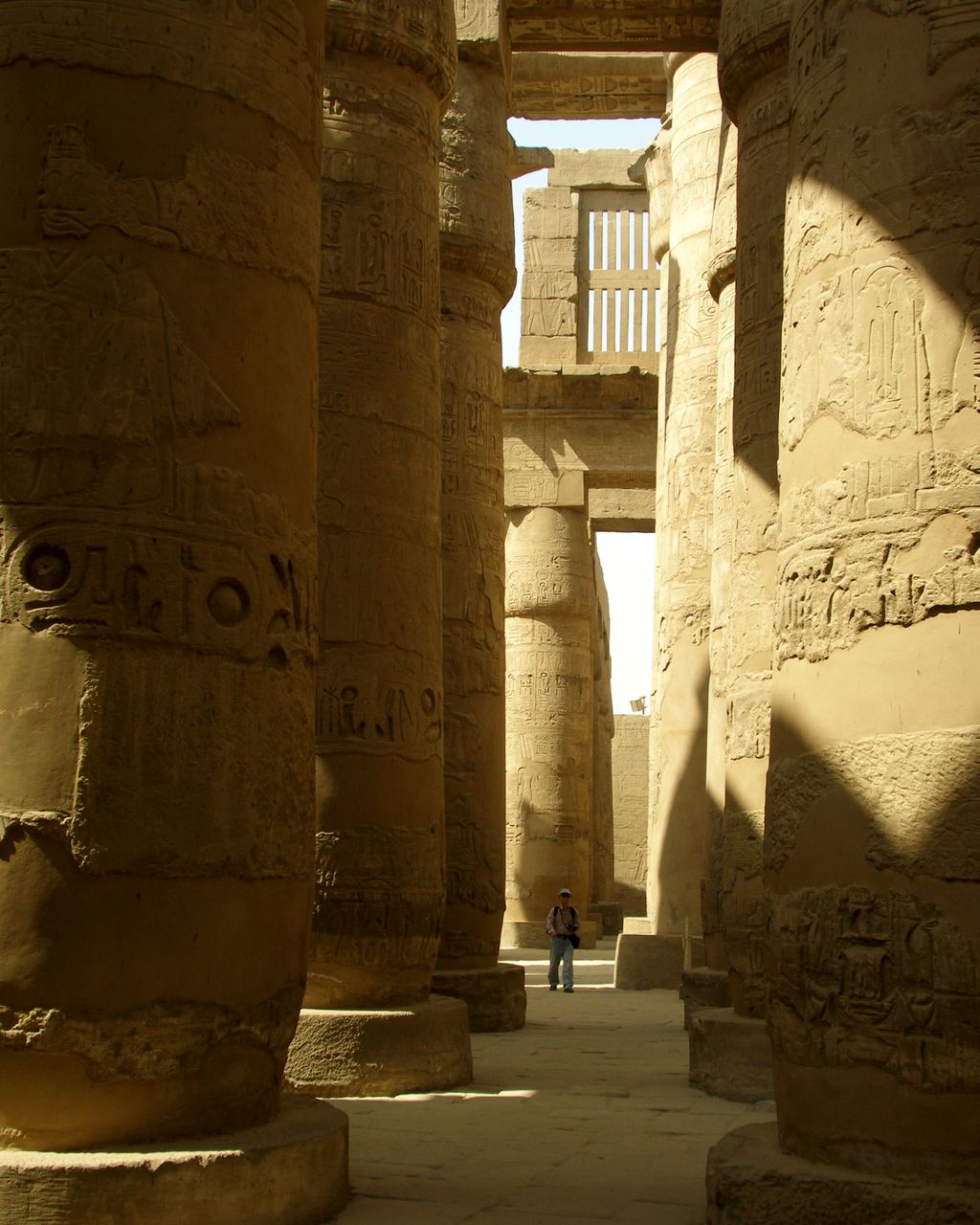
Karnak is the anchor. Building started there under Senusret I, who reigned from about 1971 to 1926 BC, and was still going on under the Ptolemies, which makes the place less a temple than a building site that stayed open for the better part of two thousand years. The Great Hypostyle Hall in the photograph is Nineteenth Dynasty work, roughly 1290 to 1224 BC, dedicated to Amun-Re. Thebes went onto the UNESCO World Heritage List in 1979, Karnak and the west bank together.
South of Luxor the river lines up Edfu, Kom Ombo and Philae, Ptolemaic temples with Roman work layered on top, and then Abu Simbel down near the Sudanese border. Most of them stand a short walk from where the boat ties up, which is the honest argument for doing this stretch by water. Abu Simbel is the exception, and comes as a separate run south from Aswan.
Season, price and the chance of not flying
Luxor flies all year, and the calendar question is less about heat than about wind. December and January give the steadiest mornings. The spring khamsin, the dusty south wind that runs roughly March to May, is what most often puts a whole fleet on the ground. In summer the pickup slides earlier still, so the flight is finished before the day builds.
Set against other destinations, Egypt sits at the bottom of the world market: a seat in a basket costs less at Luxor than almost anywhere it is sold commercially, and the gap is wide rather than marginal. That reflects local operating costs and the number of balloons sharing one airfield, not a shorter or lower flight. Nobody is selling you less air for the money.
Cancellation is decided at the launch field on the morning, not the night before, and the call goes against the balloon whenever conditions say so. Build a spare morning into the trip if the flight is the point of it. The rest is the same as anywhere: weight is declared at booking, and you fly at dawn or you do not fly.

Questions people actually ask
Where in Egypt can you ride a hot air balloon?
Luxor, and only Luxor. All 42 listings on this site lift off from the same fields on the Theban west bank. Aswan and Cairo have no commercial ballooning, so any Egyptian itinerary advertising a balloon is putting you on a Luxor morning, whatever else it includes.
Why do prices range from 35 to over 1000 EUR?
Because the packaging changes, not the flight. The cheapest listing and the one inside a four-day cruise share the same basket at the same hour of the same morning. The difference is the boat, the hotel nights, the guide and the transfers on either side of a flight that lasts about forty minutes in both cases.
What happens if the flight is cancelled during a cruise?
This is the question to ask before booking a multi-day package, because the boat sails on schedule whether or not the balloon flies. Some operators reschedule the flight to another morning of the itinerary, others refund that portion. It is rarely stated in the listing, and it is worth having the answer in writing.
Do you need to visit the Valley of the Kings separately?
Nine listings pair the flight with a guided west bank morning that includes it. On a cruise the tombs are normally part of the itinerary. A standalone flight does not include them: you land, you go back to the hotel, and the tombs are a separate trip.
When is the best month to fly in Egypt?
November to March. Luxor flies year round, but winter gives the clearest and most reliable mornings, and summer flights leave very early to be back on the ground before the heat. The cold before dawn in January is sharper than people expect for Egypt.
Data verified on . Dates and figures checked against Wikipedia, UNESCO material and agency reporting; 2025 arrivals from Egypt's State Information Service. Listing counts read from the Egyptian tours on this site.