
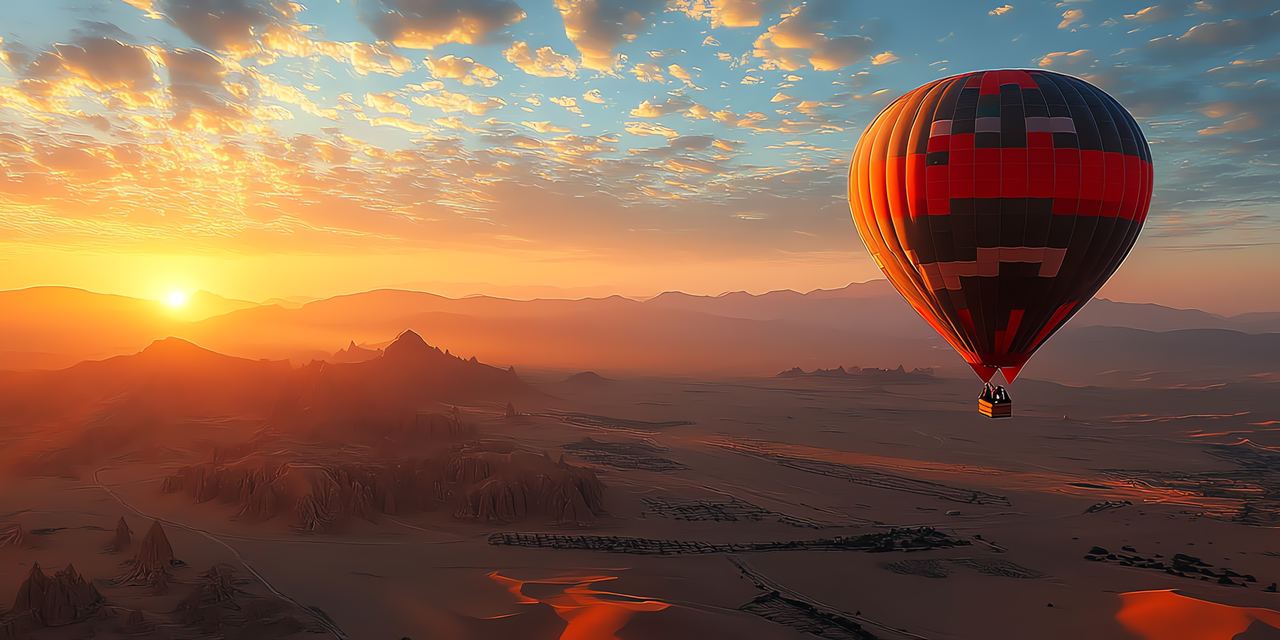
Hot Air Balloon Rides in Luxor
Sunrise rides over the Valley of the Kings and the temples of ancient Thebes.
Luxor stands on the site of ancient Thebes, and the west bank of the Nile here holds the densest concentration of monuments in Egypt: the Valley of the Kings, the terraced temple of Hatshepsut, the Colossi of Memnon. Balloons launch at dawn from the west bank on most mornings of the year, which makes Luxor one of the few places where a balloon flight is not an add-on to the trip but the best single hour of it.
Nine listings that pair the flight with a guided morning on the ground have moved to their own page, so what remains here is the flight itself: 20 ways to buy the same 40 minutes over the same ground, between 35 and 265 EUR. Before you sort by price, read what happens after the landing. Some of these put you back at your hotel by eight in the morning with the day still ahead of you. Others hand you to a guide for a full day that ends after lunch. Both are reasonable ways to spend a morning in Luxor. They are not the same purchase, and the listing titles do not always make the difference obvious.
Choose a destination in Luxor

Hot Air Balloon Experiences in Luxor

Guided Hot Air Balloon Ride over Luxor at Sunrise
A guide flies with you and explains the west bank while it is still in view. The premium end of Luxor ballooning, with commentary throughout.

Hot Air Balloon Luxor: Take Off Before Sunrise
This flight lifts off before first light, so the sunrise arrives at eye level from the basket instead of from the launch field below.

Hot Air Balloon Luxor with Hotel Transfers Included
Air-conditioned round-trip transfers from a central Luxor hotel, English live commentary and a sunrise flight over the west bank, all in one booking.

Hot Air Balloon Over Luxor: 40 Minutes Above the Tombs
A 40-minute sunrise hot air balloon ride over Luxor's west bank, flying above the temples and tombs. The simple option, with nothing else attached.

Hot Air Balloon over the West Bank of Luxor, Egypt
An early car pickup, a boat across the Nile and about an hour in the air over the west bank. A plain morning flight, back at the hotel by breakfast.

Hot Air Balloon Ride in Luxor, Early Morning Flight
The lowest-priced balloon flight on the site: an early morning ride over Luxor with hotel and cruise ship pickup included by the operator.

Hot Air Balloon Ride over Luxor's Open Air Museum
Almost everyone sees Luxor from ground level. This sunrise balloon flight reverses the angle and shows the temples as whole plans from above.

Luxor Hot Air Balloon Flight at Sunrise with Hotel Pickup
Crossing to the west bank by motorboat, then 45 to 75 minutes above the Valley of the Kings and Hatshepsut's temple. Round-trip hotel pickup included.

Luxor Hot Air Balloon Sunrise Ride, Hotel Transfers
Pickup and drop-off both included, from a Luxor hotel or a Nile cruise boat, for a sunrise flight over the west bank. Nothing to arrange at 4am.
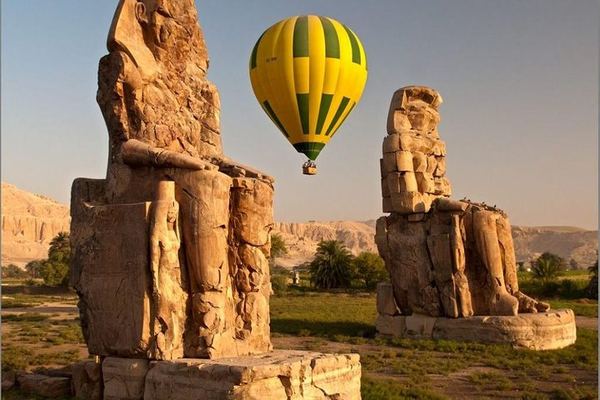
Luxor Sunrise Balloon Ride over the Nile and Mountains
Dawn balloon flight over the Luxor west bank, the Nile below and the Theban mountains catching first light. Rated 4.3 from 240 reviews.

Luxor Sunrise Balloon Ride with Transfers Included
A low-cost sunrise balloon ride over Luxor with road transfers already in the fare, so there is no taxi to arrange for the west bank at 4am.
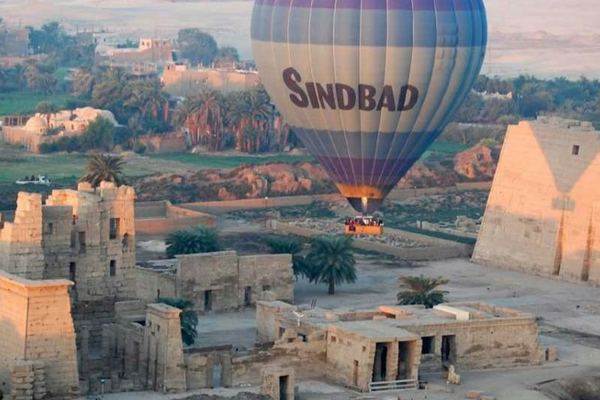
Luxor: Sunrise Hot Air Balloon Ride with Transfer
One of the cheapest Luxor balloon rides listed here, at 70 EUR with transfer included. Sunrise over the Nile, the farmland and the west bank.
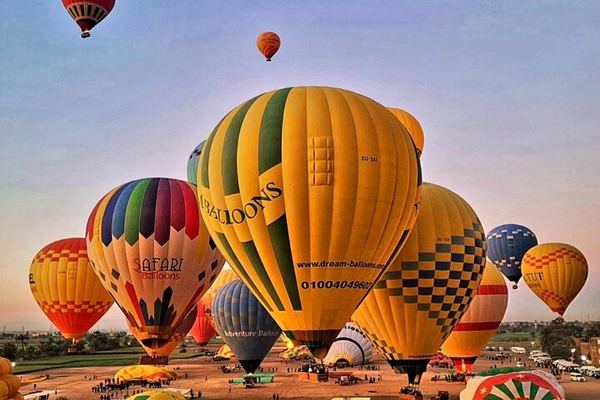
Luxor West Bank Sunrise Balloon Ride with Guide on Board
Sunrise balloon over the Luxor west bank with an English-speaking guide on board, hotel transfers and breakfast. Rated 4.8 from 25 reviews.

Luxury Balloon Flight over Luxor at Sunrise, Hotel Pickup
Pre-dawn hotel pickup and a luxury sunrise balloon flight over Luxor's west bank, with the desert light at its best and the logistics handled.

Luxury Hot Air Balloon Luxor with Private Basket
A private basket, private guide, private car and boat transfer and a premium breakfast: the luxury label here covers four specific things.

Luxury Luxor Balloon Trip: Hotel Pickup and Breakfast
Luxury Luxor balloon trip with hotel pickup and a light breakfast included. A handled-for-you sunrise flight over the world's largest open-air museum.

Private Luxor Balloon Flight at Sunrise, 3-Hour Program
Private hot air balloon flight in Luxor: a 3-hour program with about 45 minutes at sunrise over the city, in a basket reserved just for you.

Sunrise Balloon Flight Over Luxor's West Bank Temples
Shared sunrise hot air balloon flight over Luxor's west bank: 35 to 45 minutes above the temples as first light crosses the Nile valley.

Sunrise Hot Air Balloon Over Luxor's Historical Sites
Sold at 45 to 80 minutes in the air, well above the 35 to 45 minute Luxor norm, this sunrise flight buys time to drift the length of the west bank.

Sunrise Hot Air Balloon Over the Luxor West Bank
The plain version: about 45 minutes over Luxor's west bank at sunrise, hotel pickup and back again, with nothing else bolted onto the morning.
Ratings collected by Viator, Tripadvisor and Tiqets
When to fly in Luxor
Luxor runs on the opposite calendar to Europe. December to February is the peak here: around 20 °C at dawn, the clearest air of the year over the Theban west bank, and the fullest schedule — which is also why these are the months that sell out.
Flights run through the summer as well, but by June the dawn temperature is already near 30 °C and rising fast, and the flight is over before the day becomes what it is going to become. There is no month here without balloons; there are months you would rather not spend on the ground afterwards.
| 1 | 2 | 3 | 4 | 5 | 6 | 7 | 8 | 9 | 10 | 11 | 12 |
The same reading for all 31 destinations, grouped by climate, is on the season guide.
What flying here is like
Flights lift off before sunrise and stay up for 35 to 45 minutes on most programs. From the basket the geography explains itself: the green strip of the Nile valley on one side, the desert cliffs hiding the royal tombs on the other, and the temples in between catching the first light. Shared baskets, private flights and packages that pair the balloon with a guided west bank tour all fly the same sky. The difference is what happens after you land.
The three ways Luxor is sold
Same balloon, same forty minutes, three very different mornings and three very different prices. This is the comparison worth making before you sort by cost.
| What you book | Listings | Price | Your morning ends |
|---|---|---|---|
| The flight, more or less alone | 20 | 35 to 265 EUR | back at the hotel by 8am |
| Flight plus guided west bank | 9 | 62 to 176 EUR | after lunch, 6 to 11 hours |
| Flight inside a Nile cruise | 13 | up to 1015 EUR | days later, in Aswan |
Look at the first two rows again. The cheapest guided day costs 27 EUR more than the cheapest flight on its own, and for that you get transport, a guide and usually the entrance tickets to a site where tombs are ticketed individually. Arranging the same visit yourself in the afternoon means paying for a taxi and a guide separately, and doing it when the Theban hills are at their hottest.
Four thousand years on one bend of the river
Twelve dates that belong to Thebes rather than to Egypt: how a provincial town on this bend of the river became a capital, a burial ground, a ruin and a place people fly over.
The origins
-
c. 2055 BC
Thebes becomes the capital
Mentuhotep II beat the northern kings, ended the First Intermediate Period and ran the country from Waset, the town the Greeks would later call Thebes. He built his funerary complex against the cliffs at Deir el-Bahari on terraces instead of under a pyramid. Hatshepsut copied the idea next door close to six centuries afterwards.
-
c. 1971 BC
The first stone temple at Karnak
Senusret I put the first substantial stone buildings on the site, among them a small limestone barque shrine for his jubilee. Later kings pulled it down and used the blocks as fill inside the Third Pylon, where Henri Chevrier found them in 1926 and put the chapel back together. Almost every dynasty after him added something, and nobody ever finished the place.
-
c. 1500 BC
A village for the men who cut the tombs
Deir el-Medina housed the draughtsmen, stonecutters and painters of the royal tombs, walled into a hollow between the two valleys. They were literate and they wrote on limestone flakes: work rosters, absence notes, court cases, private letters. In year 29 of Ramesses III, around 1157 BC, their rations arrived 18 days late, they walked off the job and sat down at the mortuary temples, and a scribe named Amennakhte wrote up the first strike anyone recorded.
-
c. 1479 BC
Hatshepsut builds Djeser-Djeseru
Hatshepsut ruled from about 1479 to 1458 BC and cut her mortuary temple into the same bay of cliffs Mentuhotep had chosen. Her steward Senenmut is credited with the design, and the work ran some fifteen years. Reliefs on the middle terrace record her trading expedition to Punt, with the ships, the crews and the incense trees drawn out in detail.
The growth
-
c. 1350 BC
Amenhotep III builds on both banks
Amenhotep III started Luxor Temple on the east bank and raised the largest mortuary temple on the west, with two seated statues of himself at the gate. The temple was quarried for stone and washed out by the flood within a few centuries. The statues stayed where they were, and they are the Colossi of Memnon.
-
c. 1250 BC
Ramesses II and the Ramesseum
Ramesses II completed the Great Hypostyle Hall at Karnak and built his own mortuary temple across the water. Its granite colossus stood around 20 metres and weighed something near 1,000 tonnes before it fell and broke apart. Diodorus Siculus copied down its inscription in the first century BC, and Shelley turned a version of that line into Ozymandias, published in 1818.
-
663 BC
The Assyrians take Thebes apart
Ashurbanipal's army beat the Kushite king Tantamani near Memphis and reached Thebes about forty days later. They emptied the temples and carried off two obelisks plated with electrum to Nineveh. The city was rebuilt and stayed a religious centre, but it never governed anything again.
-
AD 130
Hadrian waits for a statue to sing
An earthquake in 27 BC cracked the northern colossus, and it began to give out a note at sunrise as the stone warmed. Visitors came from across the empire to hear it and carved their names on the legs. Hadrian and his wife Sabina waited three days in November 130, and the poet Julia Balbilla cut four verses into the base to record that they had heard it; Septimius Severus repaired the cracks around AD 199 and the statue has been silent since.
Today
-
AD 1286
A mosque goes up inside Luxor Temple
By the thirteenth century the temple lay under centuries of its own debris, with a village standing on top of the fill. In 1286 the son of Sheikh Yusuf Abu al-Haggag built a mosque over his father's grave, on what was in fact the roof of a pharaonic courtyard. Archaeologists dug that courtyard out beneath it much later, which is why the old mosque doorway now opens several metres above the floor.
-
1881
Fifty royal mummies come out of one shaft
The Abd el-Rassul family of Qurna had been selling papyri and canopic jars on the Luxor market for years before Mohammed Abd el-Rassul told the authorities where the material came from, on 25 June 1881. The shaft at Deir el-Bahari held more than fifty bodies, hidden there by priests of the Twenty-first Dynasty to keep them away from robbers. Ahmose I, Thutmose III, Seti I and Ramesses II were all in it.
-
1979
Thebes goes on the World Heritage list
UNESCO inscribed Ancient Thebes with its Necropolis in 1979 under criteria one, three and six, as a single property of about 7,390 hectares covering both banks. Karnak, Luxor Temple, the two valleys, Medinet Habu, the Ramesseum, Deir el-Bahari and Deir el-Medina all sit inside the boundary. So does nearly everything a balloon passes over in forty minutes.
-
2021
The processional road opens again
A paved avenue 2.7 kilometres long joined Karnak to Luxor Temple and carried the Opet festival, when the barque of Amun was taken south along it once a year. Clearing and excavating it went on in stops and starts from the middle of the twentieth century, with buildings bought out and a modern street moved. It reopened on 25 November 2021, lined with more than a thousand sphinxes and ram-headed statues, and it can now be walked end to end.


From the basket
The ground at first light
Height rearranges the west bank. On foot it is a run of separately ticketed sites with a car park at each one and a hot walk in between. From a basket it reads as a single piece of geography: a band of cultivation, a wall of limestone behind it, and every temple set in the strip where the two meet.
The order becomes obvious. Medinet Habu at the south end, the Ramesseum in the middle of the fields, the two Colossi out on their own beside the road, then the terraces of Deir el-Bahari cut back into the rock. Behind that, the mouth of the valley where the kings were buried, with the peak the Egyptians called the Horn above it, a natural pyramid.
What surprises most people is how lived-in it all is. Sugarcane, alfalfa, donkeys, flat mudbrick roofs. The old village that sat directly on top of the tombs of the nobles was cleared in the 2000s and its families moved to newer housing, but the fields below still work the way they always have.
The morning, and the ground under it
Every hotel worth the name is on the east bank and every balloon is on the west, so the day starts with a boat. Pickup runs about ninety minutes before sunrise. The crossing takes ten to fifteen minutes, usually with tea and something sweet handed round on deck, and a minibus carries you from the west bank jetty out to the launch ground behind the cultivation. You arrive while the envelopes are still flat on the sand with fans roaring into them, which is worth being early for.
Luxor baskets are big: twenty passengers in compartments is normal here, not exceptional. If your last flight was in Cappadocia or over Tuscany, expect more people at the rail and less room to move. What you get in exchange is a price no other ballooning destination in the world comes close to.
Nowhere else in the country sells this. There is no commercial ballooning at Cairo or Aswan, so a balloon ride booked anywhere in Egypt is a Luxor morning wearing a different label. It also means the ground under you is still producing: the tomb of Thutmose II was identified in these hills in February 2025, the first tomb of an Egyptian king found since Tutankhamun's in 1922.
One thing worth taking up with you. The necropolis was a workplace, and the men who cut the tombs left their own paperwork behind, this line among it, from the strike papyrus now in Turin:
It was because of hunger and thirst that we came here. There is no clothing, no ointment, no fish, no vegetables.
| Monument | What it is | From the basket |
|---|---|---|
| Deir el-Bahari | Hatshepsut's temple, three terraces built into the cliff | The clearest landmark up there on most tracks |
| Valley of the Kings | The royal burial ground, in a dry valley behind the ridge | You see the valley mouth and the cliffs. The tombs are underground and the wadi is often off to one side |
| The Ramesseum | Ramesses II's mortuary temple, with the broken colossus | Out in the fields and frequently underneath |
| Medinet Habu | Ramesses III's temple, the best preserved on the bank | At the southern end of the run, so it depends how far south you drift |
| Colossi of Memnon | Two seated statues of Amenhotep III, all that is left of his temple | Small from height but easy to find beside the road |
| Deir el-Medina | The walled village of the men who cut the tombs | A rectangle of roofless walls. Easy to miss unless someone points it out |
| Valley of the Queens | Tombs of royal wives and children, Nefertari's among them | Usually south and behind you, and not on every track |
| Karnak and Luxor Temple | The two temples on the east bank | Across the river and in the distance. No flight goes over them |

East bank
The temples you walk are not the ones you fly
Balloons work the west bank. Karnak and Luxor Temple stand on the other side of the river, so the buildings you visit in the afternoon are not the ones you looked down on at dawn. No operator can arrange otherwise.
Karnak covers around 101 hectares and was worked on for close to two thousand years, which makes it a compound rather than a building; its hypostyle hall stands on 134 columns. Luxor Temple, less than three kilometres south, is the smaller and stranger of the two. Amenhotep III began it, Ramesses II fronted it with a pylon and two obelisks, one of which has stood in the Place de la Concorde since 1836, and a Roman garrison later walled the whole thing into a fortress. The town takes its name from that: al-Uqsur, the fortifications.
The mosque in the photograph is not a relic. It holds Friday prayers, it keeps the saint's tomb, and once a year the town carries boats through the streets for his festival, a detail people have long compared with the Opet procession that used to end in the courtyard below.
Before you book
Ballooning in Luxor follows the same rules as everywhere else. Flights leave at dawn because that is when the air is calm, and the timing is not negotiable. Operators cancel when the weather says so, and a strict weather policy is a reason to trust them, not to complain. You will be asked your weight at booking; that is normal and it is about load balance, not judgment.
The season runs all year. Winter mornings, December to February, are crisp, clear and the most reliable, though cold before the burner gets going: check what to wear before packing. Summer flights leave even earlier to beat the heat. Whatever the month, book the balloon for the start of your stay, so a weather delay costs you nothing but sleep.

Questions people actually ask
How much is a balloon ride in Luxor?
From 35 EUR for a shared basket, with the median listing at 77. Adding a guided west bank tour on the ground brings the cheapest option to 62 EUR. The figures above 250 are private baskets or flights sold inside longer packages.
How long are you in the air?
Thirty-five to forty-five minutes on most programs. The whole outing runs about three hours from hotel pickup to drop-off, most of which is transfer, inflation and the drive back.
What do you actually see from the balloon?
The Theban west bank: the Valley of the Kings, the terraces of Hatshepsut's temple at Deir el-Bahari, the Colossi of Memnon, and the sharp line where the irrigated green of the Nile valley stops and the desert begins. Karnak and Luxor Temple are on the opposite bank and are usually visible in the distance rather than underneath.
When is the best time of year?
December to February, and the margin is wider than it sounds. A January dawn here is around 20 °C with the cleanest air of the year; by June it is close to 30 before the sun is properly up. Nothing stops in summer, the schedule just shifts earlier, but the hour after landing is the part you will remember for the wrong reason. Winter also books out first.
Is the Valley of the Kings included?
Only in the nine listings that pair the flight with a guided tour. A standalone flight lands you back at the hotel and the tombs are a separate trip. Note that Tutankhamun's tomb and the tomb of Seti I are not on the general Valley of the Kings ticket even when the tour is included, so check whether your listing covers them or whether you pay at the gate.
Is ballooning in Luxor safe?
The question exists because of one morning. On 26 February 2013 a balloon caught fire over the west bank as it came in to land, and 19 of the 21 people on board were killed — the deadliest ballooning accident on record. Flights stopped while the rules were rewritten and resumed with a designated launch ground, tighter maintenance checks and more pilot training. Nothing on that scale has happened here since.
Why is Luxor cheaper than anywhere else?
Basket size and volume, not a shorter flight. A seat here starts at 35 EUR against a median of about 125 in Cappadocia and 200 in Spain, and the reason is that Luxor sells twenty seats where a European operator sells eight or twelve, over the same ground, every morning of the year, with local costs to match. The forty minutes you get are the same forty minutes.
Data verified on . Historical dates checked against UNESCO and academic sources. Prices and listing counts read from the 20 Luxor flights on this site on 12 August 2026.