
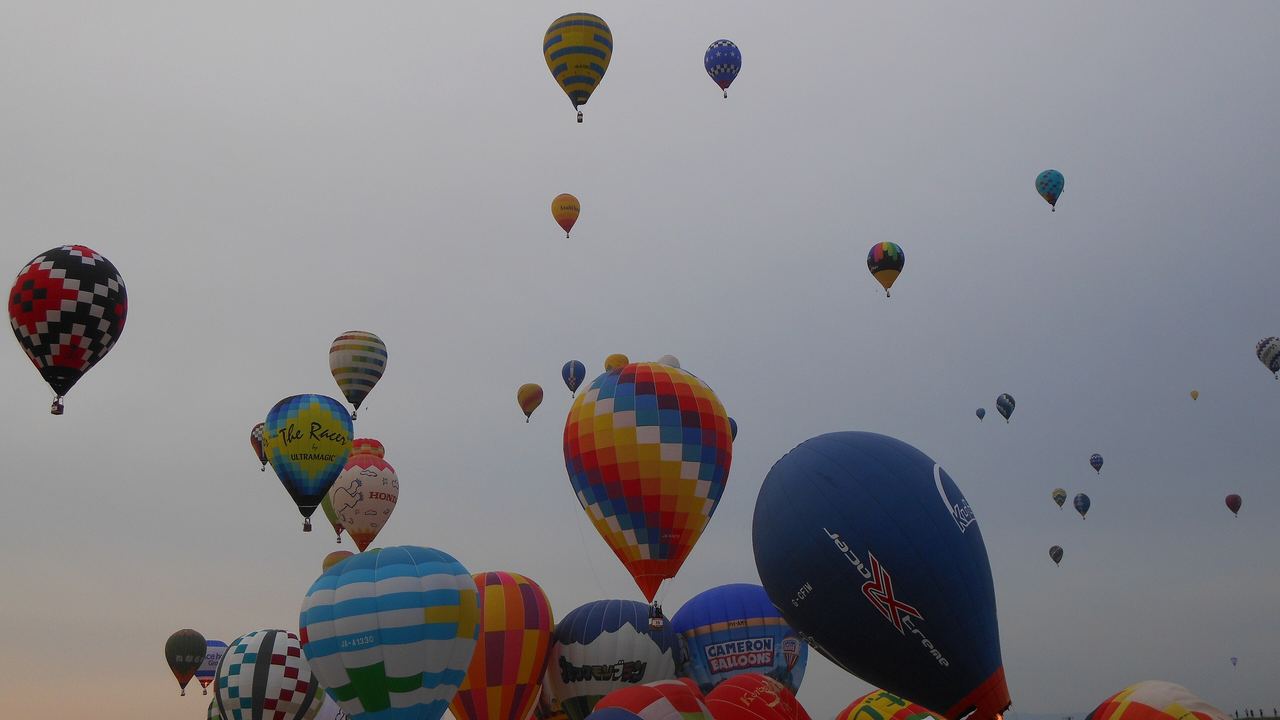
Saga draws more people than any other balloon festival in the world, and almost nothing is written about it in English. The competition flies from a riverbed outside the city, the trains from Fukuoka run extra services, and the whole thing is free to attend — see where it sits against the others.
- Status
- Active
- When
- October 28 – November 3, 2026
- Where
- Saga (JP)
- Visitors
- 907,000 (2023)
- Admission
- Free
- Flights
- no flights for the public, stated explicitly by the organiser
Official site www.sibf.jp
The largest balloon festival in the world by attendance — about 907,000 visitors in 2023, more than Albuquerque — and almost nobody writes about it in English.
Source ·
It is also the clearest case of the gap this site exists to fill: the largest gathering of balloons on earth offers the public no way to fly in one. Whatever you do at Saga, you do it from the ground.
The site is a dry riverbed on the edge of the city, wide and flat, with the competition flying over rice fields towards the Ariake Sea. Saga hosts the world championship regularly, and the flying is genuinely competitive rather than ceremonial: pilots chase targets, and spectators watch a sport rather than a spectacle. The crowd numbers come from that combination of free entry, a rail line that runs a temporary station to the field, and a region that treats the event as its own.
For a visitor from outside Japan the practical picture is unusual. There is no admission to buy and no flight to book; what there is instead is an early train, a lot of walking on gravel, and a morning that starts in the dark. Accommodation in Saga city fills for the week, and Fukuoka — an hour away by train — is where most foreign visitors end up staying.
The absence of public flights is not an oversight. A competition field with dozens of balloons working targets has no room for passenger rides, and the organisers say so plainly. If flying yourself is the point of the trip, it has to happen somewhere else, on another day.
One practical note that applies to the whole week: competition flying is decided by wind and visibility, and tasks are cancelled more often than spectators expect. The organisers post the morning's decision very early, and the difference between a full launch and an empty riverbed is a message sent before dawn. Anyone travelling specifically for this should plan for more than one morning.