Teotihuacán hot air balloon rides: the sky is the easy part, the operator is not
Seventeen flights over the same pyramids, and thirteen of them sit inside a 45 euro band. The view is identical; the paperwork behind it is not, and in 2026 Mexico's aviation regulator sealed three balloon ports in the valley.
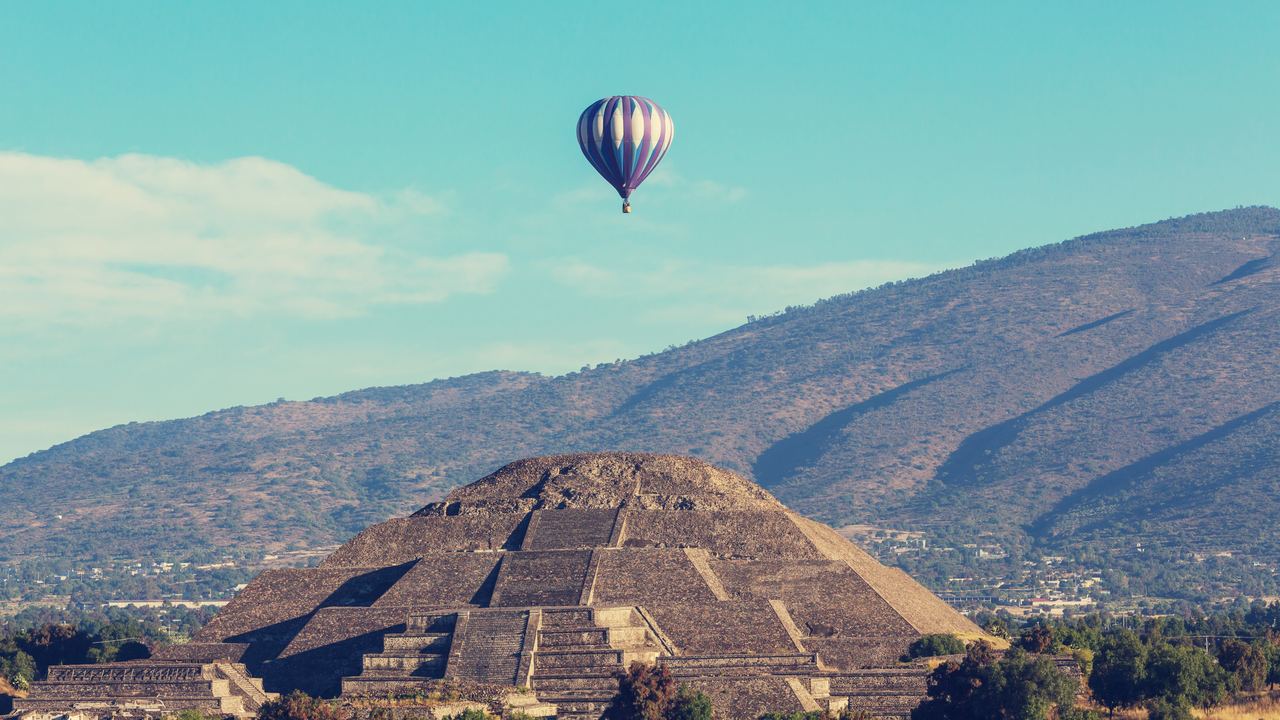
A hot air balloon ride over Teotihuacán costs 102.60 euros at the cheap end of this site's listings and 525.09 at the top. Both ends put passengers over the same pyramids, in the same hour, on the same air. Thirteen of the seventeen flights listed sit inside a single band between 102.60 and 147.90 euros, which is the tightest price cluster of any destination in this catalogue. At a glance the Teotihuacán listings look interchangeable.
They are not, and the difference has nothing to do with the view. On 29 March 2026 the Agencia Federal de Aviación Civil, Mexico's civil aviation regulator, inspected the balloon ports of the Teotihuacán valley alongside the State of Mexico government and municipal civil protection. Three establishments were sealed shut. Thirteen days earlier a balloon carrying two British passengers had struck overhead power cables and come down, cutting electricity to the area where it landed. Neither event appears on a single booking page.
Why Teotihuacán flies on so many mornings
The valley sits at about 2,300 metres in a dry basin north east of Mexico City, roughly 45 minutes by road from the edge of the capital. Dawn air there is cold and stable, layered into bands that move differently at different heights, which is the condition a balloon needs. A balloon has no heading of its own. The pilot steers by climbing and descending until the envelope finds air going the right way, which is why the whole industry lives in the first hour of light and nowhere else in the day.
The dry season runs from November to May. The rains that arrive between June and October fall in the afternoon, after the flying window has closed, so the wet half of the year grounds fewer mornings than its name suggests.
Operators in the valley advertise more than 350 flyable days a year and second place in the world after Cappadocia. That figure comes from the companies selling the flights. No aviation authority or weather service publishes a count of Teotihuacán's flying days, and the one destination that does have a published number, Cappadocia, flew on 223 days of 2025. Treat 350 as a sales figure with something real underneath it: the basin genuinely is dry, high and calm at first light for most of the year. Nobody outside the industry has counted it.
The ceiling almost nobody mentions
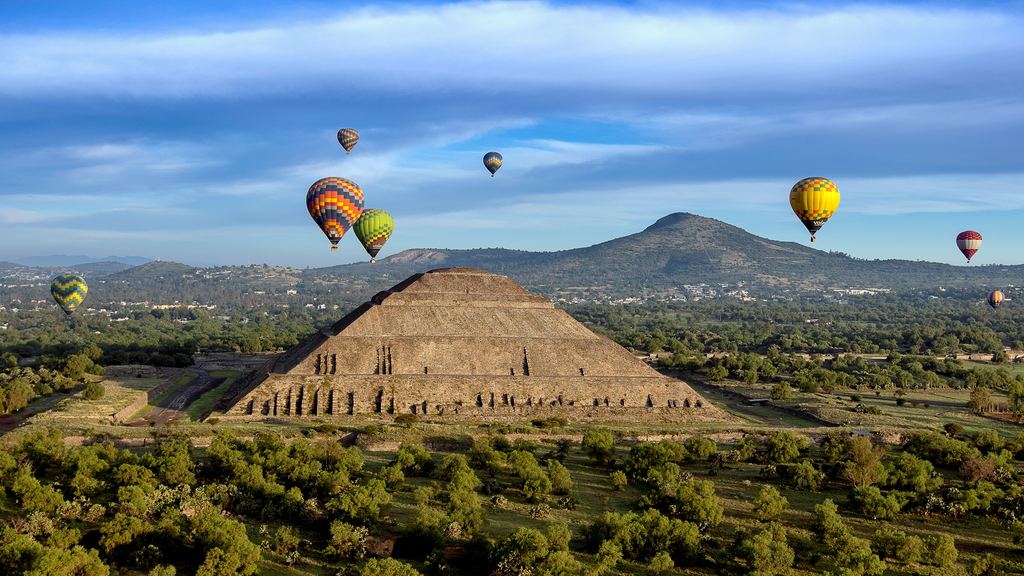
Balloons over Teotihuacán are held to 800 metres above the ground. The limit comes from the airspace rather than from the balloons: the valley lies close to Base Aérea Militar No. 1 at Santa Lucía, whose runways Felipe Ángeles International Airport now shares. Federal analysis found balloon activity over the archaeological zone posed a risk to Santa Lucía's procedures, though not to the older airport inside Mexico City, and an exclusive corridor for balloon traffic has been under evaluation since.
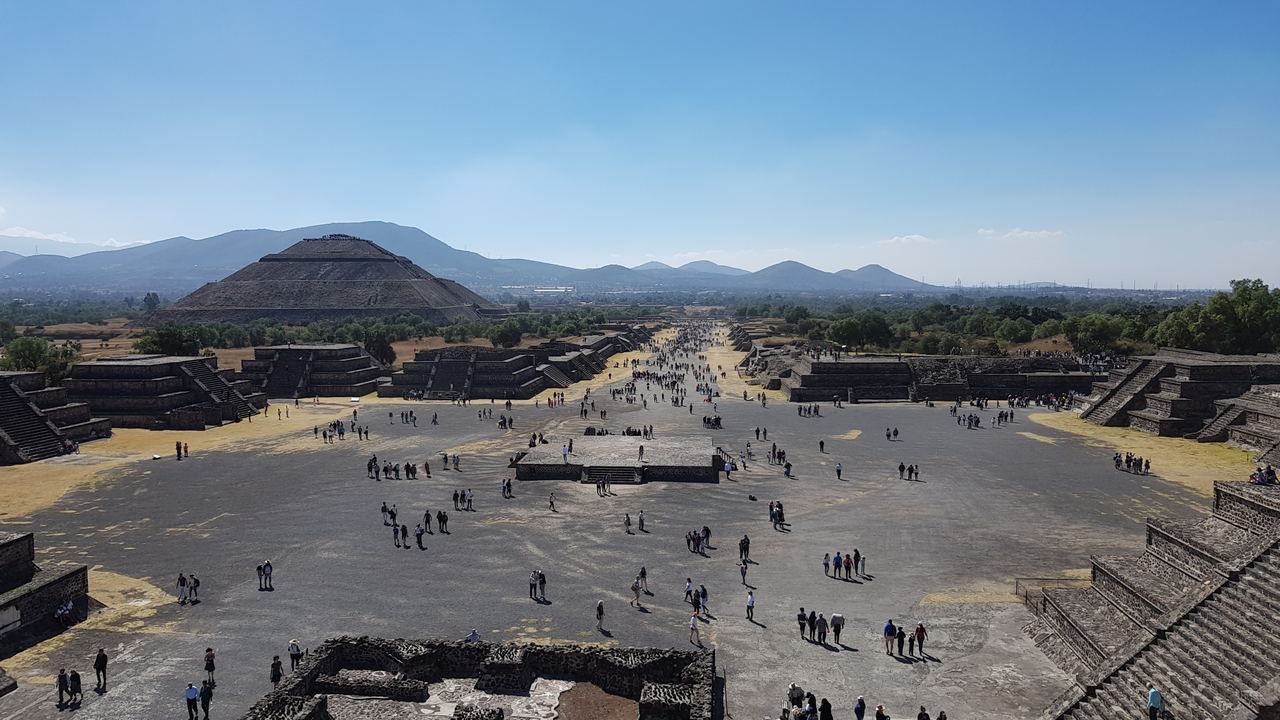
For a passenger the ceiling matters in one practical way, and it is a point in Teotihuacán's favour. The flight happens low. The pyramids stay large in the frame for the whole 30 to 50 minutes, instead of shrinking into a landscape the way they would from twice the height.
When to go, month by month
November to February is the peak: cold, still mornings and the lowest cancellation risk of the year. Operators put successful flights in that window at around 98 per cent and the wet months near 85. Those are company figures again, and they are the only ones anyone publishes. March to May flies almost as reliably and is warmer. June to October is the rainy season on paper, and in practice it is the stretch where a trip should carry a spare morning.
| 1 | 2 | 3 | 4 | 5 | 6 | 7 | 8 | 9 | 10 | 11 | 12 |
One date is worth planning around rather than avoiding. The spring equinox fills the archaeological zone: INAH counted 38,103 visitors at Teotihuacán across the weekend of 21 and 22 March 2026, part of more than 179,500 across Mexico's archaeological sites. Flights sell out well ahead of it. If the ground half of the morning is what you came for, that weekend is the worst of the year to see the site quietly and the best one to see it full.
Seventeen listings, and thirteen of them cost about the same
The median Teotihuacán flight on this site is 135.44 euros. Fourteen of the seventeen carry ratings between 4.8 and 5.0, on review counts running from 27 to 7,683, which means the star rating cannot help you choose between them. Nearly everything here is a shared basket at dawn with a hotel pickup in Mexico City. The differences are in the pickup, the breakfast and whatever ground programme is bolted on afterwards.
| What you are booking | Price here | What actually changes |
|---|---|---|
| Flight only, at the launch field | 122.55 | No transfer. Worth it only if you are already sleeping near the site, since you have to reach a balloon port on the Teotihuacán to Tulancingo road before sunrise. |
| Shared basket, pickup in Mexico City | 102.60 to 147.90 | Thirteen of the seventeen listings. Collection between 4:30 and 5:00, coffee, 30 to 50 minutes aloft, a toast on landing, breakfast. The spread inside this band buys a breakfast venue and a basket size, not a different flight. |
| Flight plus a guided day on the ground | 140.20 to 277.24 | The balloon is the first two hours. The rest is the archaeological zone on foot or by bike, and in one case the Basilica of Guadalupe. |
| Private transport, shared basket | 233.52 | A driver and guide to yourself. The basket is still shared with strangers. |
| Private basket | 525.09 | The only listing where the balloon belongs to your party. Roughly four times the shared price for the same 50 minutes. |
Sixteen of the seventeen collect passengers in Mexico City, between about 4:30 and 5:00 in the morning. Only one starts at the launch field itself, which makes it the right booking for a narrow group of people and the wrong one for everybody else. Five listings currently show a cut against a former price, the largest of them 15 per cent.

What a cave breakfast actually means
Nine of the seventeen listings put a cave breakfast in the title. It is the most repeated selling point in the Teotihuacán catalogue and the one most easily misread.
The valley is volcanic and several caverns near the archaeological zone have been fitted out as restaurants. One listing names La Gruta specifically. The rest say 'cave' or 'ancestral cave' without saying which one, so two flights at the same price can mean two different rooms. The experience is real and it is genuinely unusual. It is not a single venue, and if it is the reason you are booking, check which cavern the listing actually names.
What changed in 2026
Ballooning at Teotihuacán has grown faster than its oversight, and 2026 is the year that caught up with it. Local operators had been complaining to authorities about companies flying without full permits since well before the regulator arrived.
How the valley came under inspection
The origins
-
1 April 2023
A fatal fire over the valley
A balloon's basket caught fire in flight near the archaeological zone. A married couple aboard died and a 13 year old girl was flown to hospital in Toluca with second and third degree burns.
The growth
-
16 March 2026
A balloon into power cables
At about 8:40 in the morning a flight carrying two British passengers struck overhead cables and came down, cutting power to the surrounding area. Both were taken to a hospital in Mexico City with burns from the electrical discharge. The regulator opened an administrative investigation.
Today
-
29 March 2026
Inspection of the balloon ports
AFAC inspected the globopuertos of the Teotihuacán valley with the State of Mexico government, the state verification institute and civil protection from San Martín de las Pirámides and San Juan Teotihuacán. Forty six balloons were in operation and about half were checked.
-
Early April 2026
Three establishments sealed
Suspension seals went on three balloon operations in the valley after irregularities were found. The regulator said it would keep permanent offices in Teotihuacán and San Martín de las Pirámides, and state and federal authorities presented a ten point framework for the flights.
Three balloon ports in the Teotihuacán valley were sealed in April 2026. Not one listing selling flights from that valley changed a word.
How to check a Teotihuacán operator before you pay
When inspectors arrived at the balloon ports they asked to see a specific set of documents, and that list is the most useful thing a traveller can borrow from the whole episode. An operator flying properly at Teotihuacán holds:
- a certificate of airworthiness for the balloon
- a current insurance policy recorded in the Mexican aeronautical registry
- the balloon's certificate of registration
- the panoramic flight permit covering the operations service
- the aircraft logbook
- a commercial balloon pilot licence
- the pilot's psychophysical aptitude certificate
Nobody is going to audit a logbook at five in the morning in the dark. Two of those are checkable in the field without embarrassing anyone: the registration is painted on the envelope, and the pilot's licence can be asked for. Operators that comply say so on their own pages and expect the question. The rest comes down to booking something that names the company rather than selling an anonymous seat, and noticing whether the listing tells you who is flying it at all. The general version of this argument is in the guide to choosing a safe operator.

The ground half of the morning
Most Teotihuacán packages land you at the archaeological zone by mid morning, and the rules there changed recently too. Entry has cost 210 pesos for foreign visitors and 105 for Mexican residents since 1 January 2026, free for under 13s, for over 60s with an INAPAM card and for visitors with disabilities. The site opens at 08:00 and closes at 17:00.
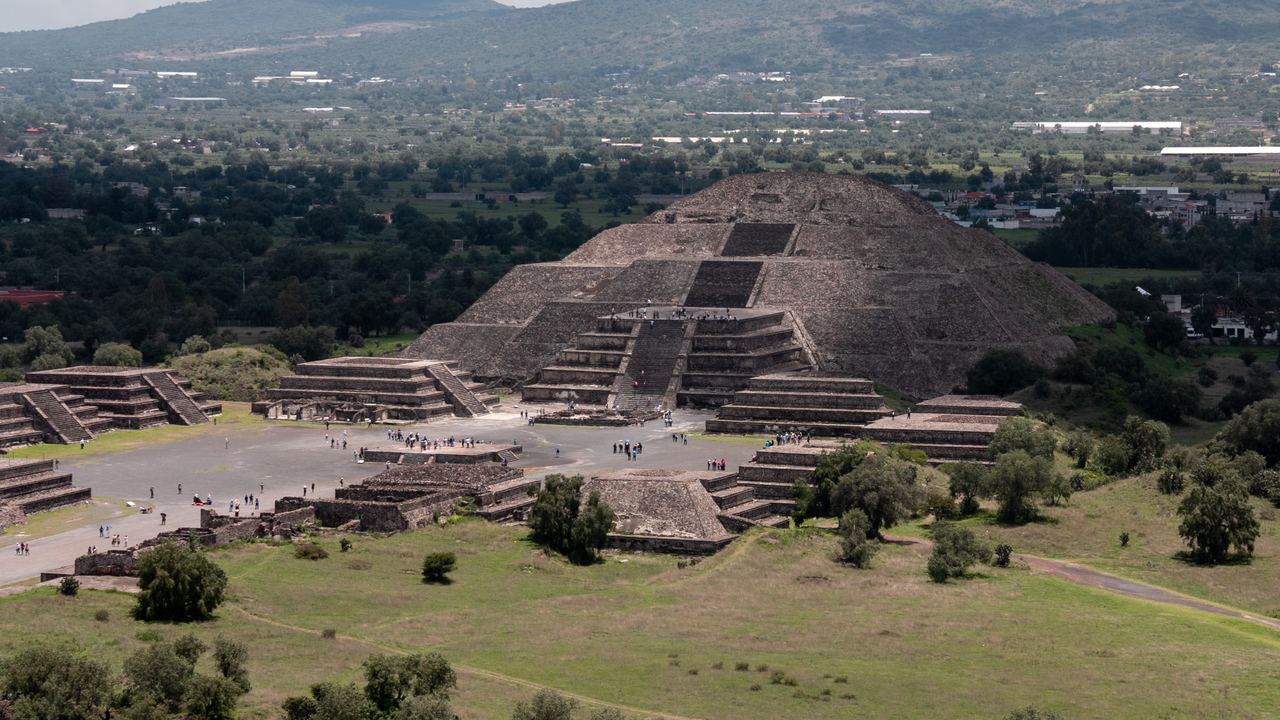
Climbing the Pyramid of the Sun has been prohibited since 2021 and still is. The Pyramid of the Moon reopened to climbers after five years closed, but only as far as the first section, five platforms and 47 steps. The upper levels stay shut. Anyone booking on the strength of a photograph taken from the top of the Sun is booking something that no longer exists.
Check whether the ticket is inside your package. Several listings include entry and a guide, the cheaper flight only bookings do not, and while the gap is small it is the kind of detail that turns a 102 euro flight into a 115 euro morning. The wider picture of what a ride costs and why is in the cost guide, and the rest of the country's flying is on the Mexico page.
Balloon flights over Teotihuacán
All of them launch at dawn over the same archaeological zone.

Balloon Flight over the Teotihuacan Valley with Cave Breakfast and Pyramids
A 30-50 minute shared flight over the Teotihuacan Valley, sparkling wine toast and diploma, cave breakfast and 1.5 hours on foot among the pyramids.
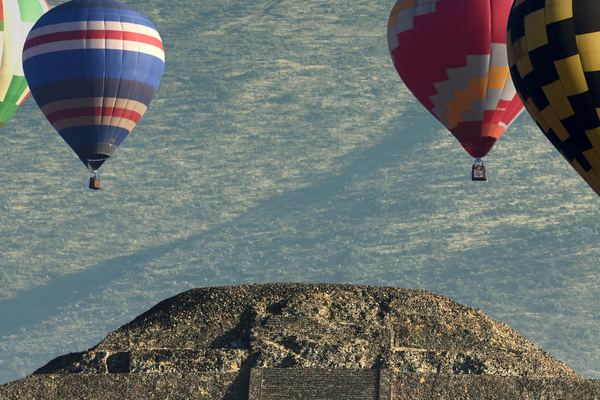
Hot Air Balloon Ride Over Teotihuacan from Mexico City
Pickup from four Mexico City points before dawn, 30 to 60 minutes over the Avenue of the Dead, then breakfast at La Higuera and two hours in the ruins.
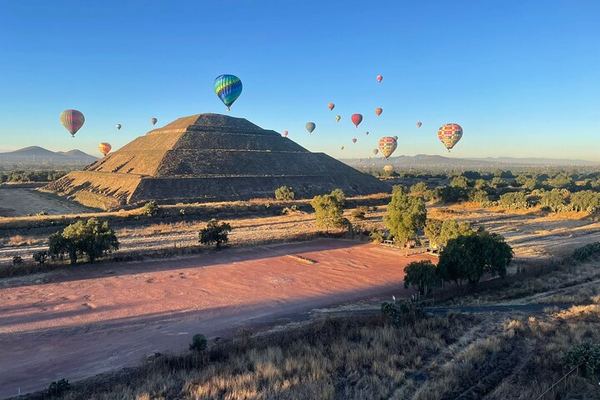
Sunrise Balloon Flight over Teotihuacan with Breakfast in the Cave
Sunrise flight over Teotihuacan with federally certified guides, American breakfast at the best known restaurant in the valley and an obsidian workshop.

Teotihuacan Balloon Flight, Ancestral Cave Breakfast and Pyramids
Dawn flight over the pyramids, then breakfast inside the Ancestral Cave, a natural grotto with a restaurant. Obsidian workshop and free time in the ruins.
Ratings collected by Viator, Tripadvisor and Civitatis
Questions worth asking first
What is the best month for a balloon ride over Teotihuacán?
November to February. The basin is in its dry season, dawn air is cold and stable, and operators put the success rate for those months near 98 per cent. March to May flies almost as reliably and is warmer. June to October is the rainy season, but the rain is an afternoon event and the balloons go up before it, so the wet months cost fewer mornings than travellers expect. Whichever month you choose, leave a spare morning in the trip.
How much does a Teotihuacán balloon flight cost?
Between 102.60 and 525.09 euros on this site, with a median of 135.44. Thirteen of the seventeen listings sit between 102.60 and 147.90, so an ordinary shared flight with a Mexico City pickup runs about 120 to 140 euros. Above that band you are buying a private basket or a guided day on the ground rather than a different flight. Everything is on the Teotihuacán page.
Is the cheapest flight a worse flight?
Not on its own. Inside that 45 euro band the variables are the breakfast venue, the basket size and whether transfers are included, and the time aloft is the same 30 to 50 minutes over the same zone. What should move you off the cheapest option is not the number but whether the listing names an operator, and what that operator can show you at the field.
What happens if the weather cancels the flight?
Balloons here do not launch in active rain, dense fog or winds above roughly 15 to 20 km/h, and the decision gets made at the field in the dark. Whether you are rebooked or refunded depends on the listing rather than on any local rule, so that clause is worth reading before you book. A cancellation is a safety decision working correctly, which is the argument the guide to how safe balloons are makes at length.
Is ballooning at Teotihuacán safe?
The valley has a real safety record and a real regulatory problem, and they are separate questions. A basket fire killed two passengers in April 2023, and in March 2026 a balloon struck power cables and injured two more. The regulator inspected the balloon ports that month and sealed three of them in April. The companies still flying hold federal certification, but there is no public register a traveller can consult, which is why the document checks above are the practical substitute.

Where the facts come from: prices, ratings and listing counts were read from this site on 12 August 2026. The accident of 16 March 2026 and the inspection of 29 March were checked against Proceso, El Universal, El Imparcial, La Jornada, Infobae and LBC; the April 2023 fire against CBS News and NBC News. Reports differ on whether the figure of 23 balloons refers to those inspected or those found irregular, and the more detailed accounts say 23 of the 46 in operation were checked, which is the reading followed here. Entry prices, opening hours and pyramid access come from INAH. The 800 metre limit derives from AFAC circular CO AV-91.03/24 as cited by operators in the valley. Success rates are operator figures.
Data verified on . Prices read from this site on 12 August 2026. Accident and inspection reporting cross-checked across six outlets; site access and visitor figures from INAH.