Breakfast in a cave at Teotihuacán: which cave, and what the package actually includes
Nine of the seventeen Teotihuacán balloon flights listed here sell a cave breakfast. They do not all mean the same cave: the itineraries point at three different addresses, and in eight of the nine the cave is an option rather than the price.
Nine of the seventeen hot air balloon flights over Teotihuacán listed on this site put a cave breakfast in the title. It is the most repeated promise in the catalogue, and it is not one promise. Read the itineraries against each other and those nine listings point at three different street addresses. Two of them sit about 300 metres apart on the edge of the same village. The third is nearly two kilometres west, on the other side of the archaeological zone.
None of this is a scam. The cave restaurants are real, there is more than one of them, and eating underground after a dawn flight is a genuinely strange and good way to spend a morning. But the phrase has become the thing that sells the package, and the phrase does not tell you which room you are booking, whether breakfast is inside the price you clicked, or whether you can get into the ruins afterwards. Those three answers live in the small print, and they vary between listings far more than the prices do.
The cave came before the city
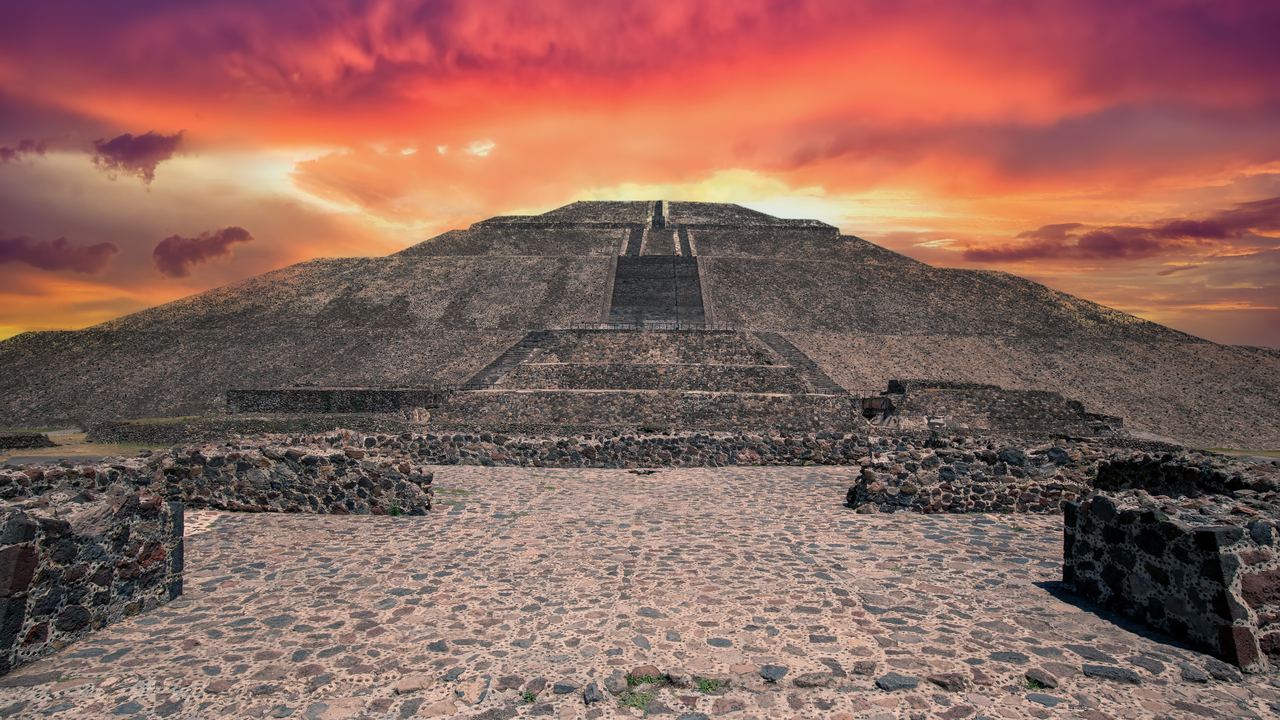
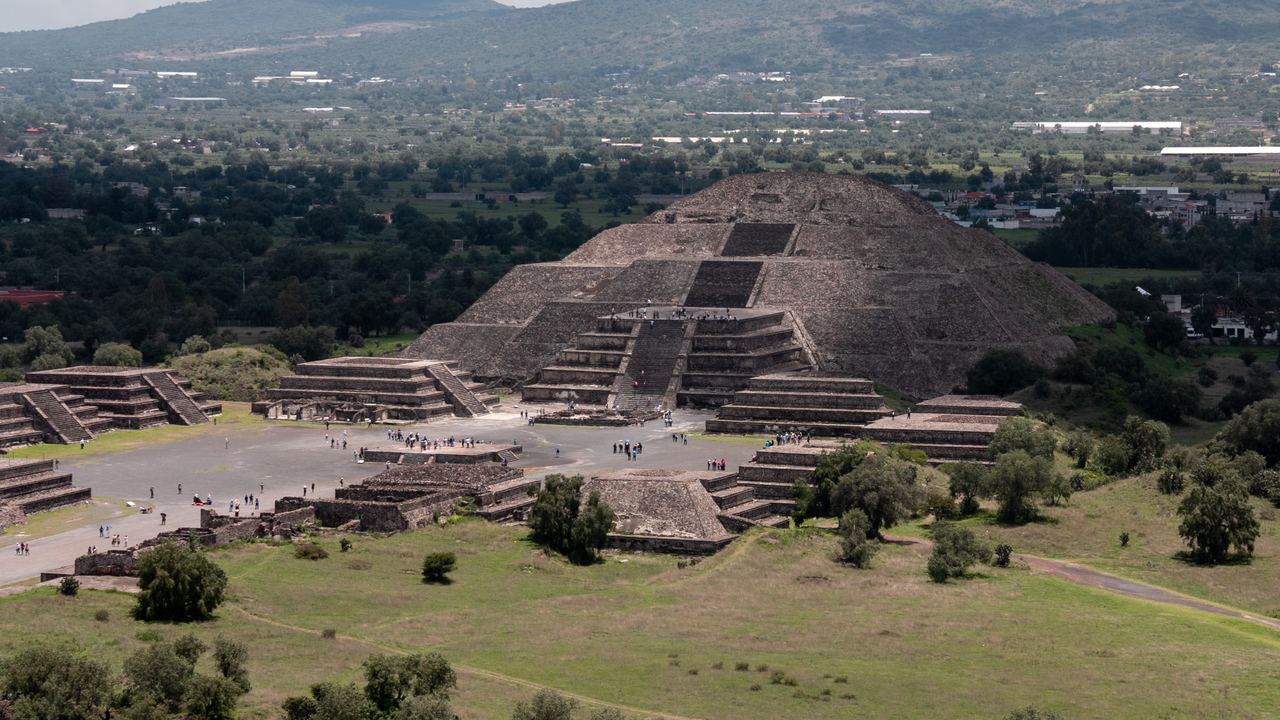
Teotihuacán is built on top of a cave, and that is not a figure of speech. In 1971 archaeologists found an entrance under the western staircase of the Pyramid of the Sun. It opened into a tunnel running roughly 100 metres east and ending in a four-lobed chamber directly beneath the centre of the pyramid. The tunnel is largely a natural lava tube. The people of the city reinforced it with mud and basalt slabs, some of which are still in place, and left offerings inside it. How much of it they enlarged by hand is still argued over.
The sequence, though, is not in dispute. The cave was there first and the pyramid went up over it. In Mesoamerican thought caves were entrances to the underworld and places of emergence, which is a reason to build a mountain on one rather than next to one.
So the valley floor is porous. The volcanic activity of Cerro Gordo and the Patlachique range that left the tube under the pyramid left others nearby, and people have been using them ever since. The cavity that is now the La Gruta restaurant is reported to have held maize and grain during the city's apogee, between roughly 100 BCE and 650 CE. Two thousand years later it holds balloon passengers at eight in the morning.
How a storeroom became a breakfast
The origins
-
100 BCE to 650 CE
The hollows are put to work
During the life of the city the volcanic cavities in the valley floor are used for storage. The one that is now La Gruta is reported to have held maize and grain.
-
1904
The ruins get a rescue project
Porfirio Díaz puts the archaeological rescue of Teotihuacán in the hands of Leopoldo Batres, in the run-up to the centenary of independence.
The growth
-
9 April 1906
A president eats underground
Díaz has lunch inside the cave that is now La Gruta. The restaurant dates its founding to that day. The encyclopaedic account has private banquets from 1906 and the public restaurant opening in 1926.
-
1971
The cave under the Pyramid of the Sun
An entrance is found beneath the pyramid's western staircase. Behind it runs a tunnel about 100 metres long, ending in a four-lobed chamber under the centre of the pyramid, largely a natural lava tube reinforced with mud and basalt.
Today
-
September 2026
Nine listings, three addresses
Nine of the seventeen Teotihuacán balloon flights on this site sell a cave breakfast. Their itineraries point at three different addresses, and in eight of the nine the cave is an option rather than the price on the card.
Two caves, three addresses
La Gruta is the one with the history. It sits about 200 metres from Gate 5 of the archaeological zone, behind the Pyramid of the Sun, in a natural volcanic cavity. Its own account starts on 9 April 1906, when Porfirio Díaz ate there during the excavation project he had commissioned two years earlier, and the owners of what was then a storeroom decided other people should be able to do the same. The English-language record splits that story in two: private banquets from 1906, a public restaurant from 1926. We have followed the more circumstantial version and flagged the gap, because the two accounts do not agree and no listing selling you breakfast there mentions either one. Frida Kahlo and Diego Rivera ate in that room. So did Jorge Luis Borges and Queen Elizabeth II.
La Cueva is a different restaurant. It stands between Gates 4 and 5, at the entrance to the village of San Francisco Mazapa, roughly 300 metres from La Gruta and also inside a natural cavity. It has its own entry in the State of Mexico's restaurant directory and its own reviews. The two are not variants of the same place, and a listing that says only "cave" is not telling you which one you are getting.
Then there is a third. One listing offers a choice between a buffet restaurant in San Martín de las Pirámides and a cave, and its cave is at neither of the above addresses: it is out by the cactus garden on the Camino Real, on the western edge of the zone, about two kilometres from the other two.
One listing calls its cave unique in the world and says it is the only company with access to it. Four other listings on this site put a stop at the same street address.
That exclusivity claim is worth pausing on. The listing at 148.01 euros describes its breakfast venue as a grotto that is "100% natural and unique in the world" and states that it is the only company able to get in. Four other listings here send their passengers to the same address, and one of the balloon operators publishes a public page about the restaurant. Whatever arrangement exists, exclusive is not the word for it.
| The listing, and its price here | Where the itinerary puts breakfast | The zone entry ticket |
|---|---|---|
| La Gruta breakfast and pyramids tour, 102.68 | La Gruta, named outright, with the dish chosen from a fixed list | Included only in the all-inclusive package |
| Cave breakfast, pyramids and pickup, 103.83 | Your pick at booking: a cave on the Camino Real, or a buffet restaurant in San Martín | Not included, quoted at 10 USD or 210 MXN |
| Valley flight with cave breakfast, 121.53 | The La Cueva address, restaurant not named | Not included |
| Cave breakfast and pyramids from Mexico City, 128.96 | La Cueva, named in the text | Not included, quoted at 5 USD |
| Cave breakfast and pyramids from CDMX, 129.78 | The La Cueva address, restaurant not named | Included with the all-inclusive option, guide as well |
| Cave breakfast and pyramid entry, 135.03 | Stops recorded at both cave addresses; the title has just been changed to name La Gruta | Included on the all-inclusive, excluded on the basic tour |
| Cave breakfast, pyramids and CDMX pickup, 140.17 | The La Cueva address, named in the notes, opens at 08:30 | Not included; a certified guide is a further 300 MXN |
| Ancestral cave breakfast and pyramids, 148.01 | The La Cueva address, sold as exclusive | Not included, quoted at 6 USD |
| Sunrise flight with breakfast in the cave, 202.54 | The La Gruta address, called the best known restaurant in Teotihuacán | Not included, said twice |
| Volare flight from Mexico City, 135.55 | No cave. Breakfast at the balloon port, with mariachi | Not included, quoted correctly at 210 MXN, cash at the gate |
| Same operator as row six, buffet version, 139.70 | No cave. A buffet, and it costs 4.67 euros more than the cave | Included, but only on the options with transport |

The half of the morning that is identical
Everything before breakfast is close to interchangeable. Pickup in Mexico City between 4:00 and 5:00, the drive out, coffee and cookies at the balloon port, 30 to 50 minutes in the air, a landing wherever the wind allows, then the sparkling wine toast and the certificate that ballooning has handed out since the eighteenth century.
The flight is not where these listings differ, and the ratings will not separate them either. What differs is the three hours after the basket is packed away, which is precisely the part described in one adjective.
The word doing the work is "option"
The price on a listing card is almost always the cheapest option inside that listing, and the cheapest option is usually the flight on its own. The cave is a fork in a dropdown menu further down the page. Here is how eight of the nine phrase it in their own inclusion lists:
- "Breakfast in a 100% natural underground cave (optional)"
- "Mexican breakfast in a natural cave (if the full tour is selected)"
- "Breakfast in the Cave if the option with breakfast is chosen"
- "Breakfast in a natural cave if you choose this option"
- "Breakfast in a Natural Cave (All Inclusive Package)"
- "Breakfast in RESTAURANT IN CUEVA (If you choose the option with Cueva)"
And the blunt one, from the listing whose title promises a cave breakfast and pyramid entry, filed under what is not included: "Breakfast in the cave (on tour No transportation and no breakfast)".
Only one of the nine, the most expensive at 202.54 euros, includes the breakfast unconditionally. In one case the same listing carries transport as an option too, so the headline price buys a balloon ride and a car park 50 kilometres from your hotel. That is a defensible way to sell a flight to somebody staying nearby. It is a poor way to buy one if you skimmed the title.
What the Teotihuacán cave breakfast actually puts on the plate
Two of the nine listings publish a menu. One gives you coffee or tea and a single dish chosen from an omelette, chilaquiles with or without meat, or a vegan option, and states that anything else from the menu is billed separately. The other describes an American breakfast: coffee, juice, bread, and a choice between eggs done as you like them, ranch eggs, or chilaquiles with meat, chicken or an omelette.
The remaining seven say "Mexican breakfast", "traditional Mexican breakfast", or just "breakfast". That is not necessarily worse food. It is an unknown quantity in a package sold on the strength of a meal, and the difference between a fixed plate and an open menu is the difference between a breakfast that is paid for and a breakfast where the coffee refill appears on a bill in a currency you are still doing arithmetic in.

The ticket the cave breakfast packages leave out
Entry to the archaeological zone costs 210 pesos for general admission, a rate that took effect on 1 January 2026. Mexican nationals and foreign residents with documents pay half, 105 pesos, and get in free on Sundays. Under 13s, INAPAM cardholders, students and teachers with credentials, and visitors with disabilities are exempt.
Six of the nine cave listings exclude that ticket outright. The other three include it, but only on their most expensive option, which means the version of the listing most people compare on price does not cover it. One listing puts the distinction with unintentional precision in its inclusions: "Time to enter the archaeological zone is included, does not include the entrance ticket." You are being sold the hour, not the entry.
Worse, the listings do not agree on what the ticket costs. Three of them quote it, at 5 USD, at 6 USD and at 10 USD. Only the last is close to 210 pesos; the other two would need the peso trading at levels it has never reached. A fourth listing, one with no cave in its title at all, is the one that gets it right: 210 pesos, in cash, at the entrance to the site. Bring the cash. And if a guided walk through the ruins is part of why you booked, check whether you have one: a certified guide is an extra 300 pesos per person on one listing, and another excludes a guide inside the zone in capital letters.

The queue at half past eight
Three separate listings warn about the same thing, in three different sets of words. One says the restaurant opens at 08:30 and the wait can run to 40 minutes, and that the itinerary is sometimes reordered to dodge it. Another says the cave keeps very specific hours and there can be a wait to get in. A third says getting in is slow at times and that this part is outside the operator's control.
Put those together with the schedules and the reason is obvious enough. Breakfast is timetabled between 08:00 and 09:00 in every itinerary that gives times, a dozen or more balloons come down within the same half hour, and a cave has the seating a cave has. Nobody is going to enlarge the room. If your day has a hard commitment before early afternoon, that queue is the part of the morning most likely to eat it: the listings that give a return time put you back in Mexico City between one and two in the afternoon, and that is the version where nothing goes wrong.
The other numbers in the small print
Two more things move the real cost, and neither is in any title.
The first is weight. Balloons are sold by lift, so most Teotihuacán operators charge above 100 kilos, and the charge is wildly inconsistent. Six of the nine cave listings ask 35 pesos per extra kilogram. Two ask 500 pesos flat between 100 and 120 kilos, 1,000 up to 140, and on one of them 1,500 above that. The same passenger, on the same morning, over the same pyramids, pays 350 pesos with one company and 500 with another for the first ten kilos. Our guide to who can fly covers the limits themselves; here the point is only that they are priced, and priced differently.
The second is gratuities, excluded by name in three listings, plus photo and video packages sold at the balloon port after landing. The wider argument about what a flight costs and why is in the cost guide.
How to read one of these listings before you pay
This is not an argument against booking one. A cave breakfast is a better morning than a hotel buffet, the restaurants are real, and the ground half of a Teotihuacán package is the part travellers remember after the flight blurs into other flights. It is an argument for five minutes of reading.
- Find the address, not the adjective. The itinerary tab carries a street address for the breakfast stop even when the description says only "a natural cave". That address tells you which restaurant you are getting.
- Check which option carries the breakfast. If the inclusion line has a bracket in it, the price you are looking at probably is not the one with the cave.
- Count the ticket separately. 210 pesos, cash, unless your listing says otherwise on the option you actually pick.
- Ask about the guide. Free time in the ruins and a guided visit are different products, and one listing prices the difference at 300 pesos.
- Ask what the fixed menu is. Two listings tell you. If yours does not, assume one plate and one drink.
The rest of the Teotihuacán field, including who is licensed to fly it after the inspections of March and April, is in our piece on choosing a Teotihuacán operator. The flights themselves are on the Teotihuacán page, and the rest of the country's ballooning on the Mexico page.
Balloon flights over Teotihuacán
Every one of them lands in time for breakfast. Which breakfast is the question.

Balloon Flight over the Teotihuacan Valley with Cave Breakfast and Pyramids
A 30-50 minute shared flight over the Teotihuacan Valley, sparkling wine toast and diploma, cave breakfast and 1.5 hours on foot among the pyramids.
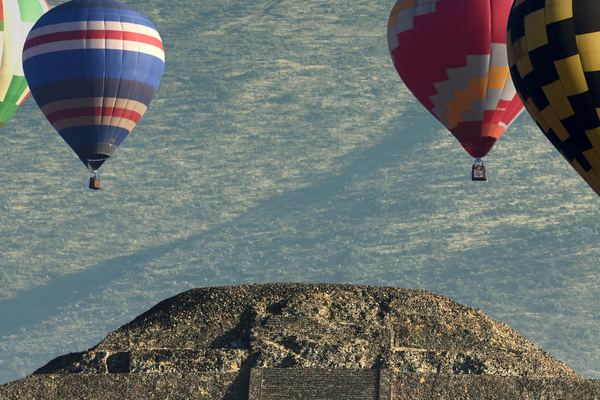
Hot Air Balloon Ride Over Teotihuacan from Mexico City
Pickup from four Mexico City points before dawn, 30 to 60 minutes over the Avenue of the Dead, then breakfast at La Higuera and two hours in the ruins.
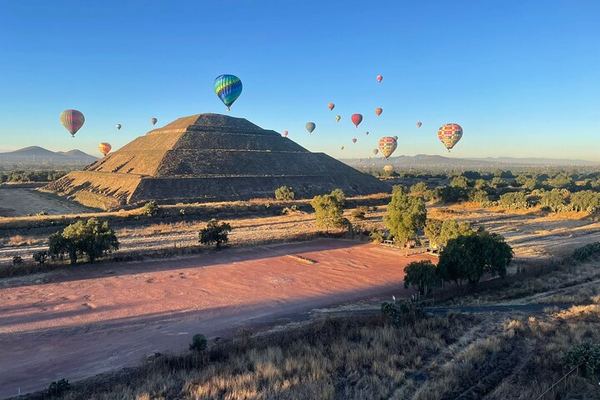
Sunrise Balloon Flight over Teotihuacan with Breakfast in the Cave
Sunrise flight over Teotihuacan with federally certified guides, American breakfast at the best known restaurant in the valley and an obsidian workshop.
Teotihuacan Balloon Flight, Ancestral Cave Breakfast and Pyramids
Dawn flight over the pyramids, then breakfast inside the Ancestral Cave, a natural grotto with a restaurant. Obsidian workshop and free time in the ruins.
Ratings collected by Viator, Tripadvisor and Civitatis
Questions worth asking before you book
Which cave do the Teotihuacán balloon packages actually use?
One of at least three. La Gruta sits about 200 metres from Gate 5, behind the Pyramid of the Sun, and is the one with the history. La Cueva is a separate restaurant between Gates 4 and 5, roughly 300 metres away. A third cave, used by one listing as an alternative to a buffet, is about two kilometres west by the cactus garden. Only two of the nine listings name their restaurant; for the rest, the address in the itinerary is the way to tell.
Is the cave breakfast included in the price I can see?
Usually not at the headline price. In eight of the nine listings that advertise it, the breakfast belongs to an option inside the listing rather than to the cheapest version of it, phrased as "if the full tour is selected" or "All Inclusive Package". Only the most expensive of the nine, at 202.54 euros, includes it unconditionally. On one listing the transport from Mexico City is an option too.
Is entry to the pyramids included?
Rarely. General admission to the archaeological zone is 210 pesos as of 1 January 2026, half that for Mexican nationals and foreign residents, who also enter free on Sundays. Six of the nine cave breakfast listings exclude the ticket, and the three that include it do so only on their top option. Carry cash: the site sells tickets at its own windows.
Is the cave breakfast worth paying extra for?
The nine listings run from 102.68 to 202.54 euros with a median of 129.78, and the flight inside them is the same 30 to 50 minutes over the same zone. So you are paying for a room and a plate, not for a better ride. One listing from the same operator charges 4.67 euros more for a buffet than for the cave, which gives a rough sense of what the cave is worth to the people selling it. If eating underground is the reason you are booking, pick the listing that names its restaurant.
What time is breakfast, and can there be a wait?
Between 08:00 and 09:00 in every itinerary that gives times. Three listings warn independently that entry to the cave can be slow, one of them putting the wait at up to 40 minutes and noting that the order of the morning is sometimes changed to avoid it. A dozen balloons land within the same half hour and the room does not get bigger. Expect to be back in Mexico City between one and two in the afternoon.
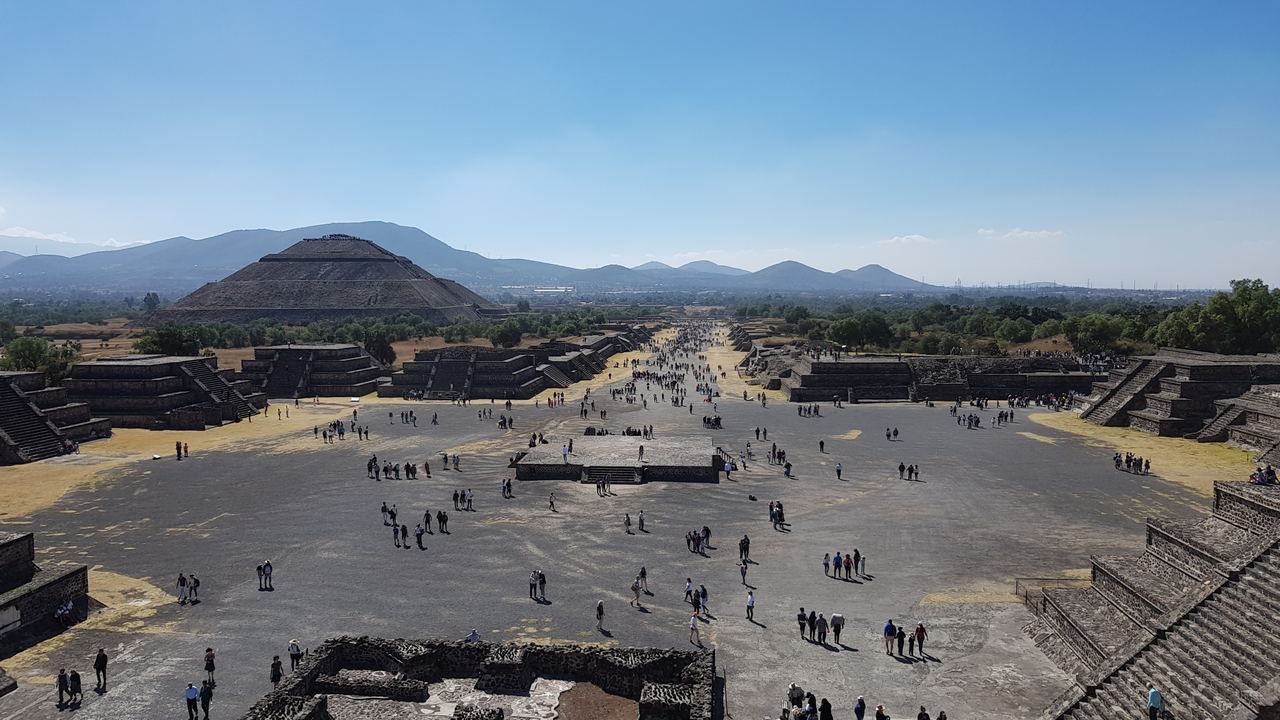
Where the facts come from: prices, inclusions, exclusions, itinerary addresses and breakfast times were read from this site's seventeen live Teotihuacán listings on 2 September 2026, and the quoted phrases are the operators' own wording as it reaches us from the providers. The 2026 entry tariff was checked against INAH's published rates as reported by several Mexican outlets. The 1971 tunnel under the Pyramid of the Sun and its lava tube origin come from the archaeological literature. On La Gruta's founding the sources disagree: the restaurant dates itself to Porfirio Díaz's lunch of 9 April 1906, while the encyclopaedic account separates the private banquets of 1906 from a public opening in 1926, and this piece follows the second as the more circumstantial. One listing changed its title from "Cave Breakfast" to "Breakfast at La Gruta" on 27 August 2026, which is how we know its cave moved.
Data verified on . Prices, inclusions and itinerary addresses read from this site's 17 live Teotihuacán listings on 2 September 2026. Entry tariff from INAH's 2026 rates.